
The bottom line
ISO 2360:2017 and ISO 2178:2016 are a complementary pair. To decide which to use, ask one question: is the substrate ferromagnetic. If yes, use 2178; otherwise, if it is conductive, use 2360.
Scope and principle
Full title: “Non-conductive coatings on non-magnetic electrically conductive base metals — Measurement of coating thickness — Amplitude-sensitive eddy-current method”.
Principle: a high-frequency coil (>1 MHz) induces eddy currents in the conductive substrate; the coating thickness changes the distance between the coil and the substrate, which changes the coil impedance. The gauge measures this impedance change and converts it to thickness.
Key facts
| Item | Content |
|---|---|
| Number | ISO 2360:2017 (updated 2017-07-01) |
| Issuing body | ISO / TC 35 |
| Principle | Amplitude-sensitive eddy-current method |
| Frequency | > 1 MHz high frequency |
| Substrate | Non-magnetic conductive metals (aluminium, copper, brass, austenitic stainless steel) |
| Coating | Non-conductive (paint, anodized film, plastic, powder, enamel) |
| Chinese equivalent | GB/T 4957 |
| US practice | ASTM D7091-22 (non-ferrous clauses) |
Application scenarios
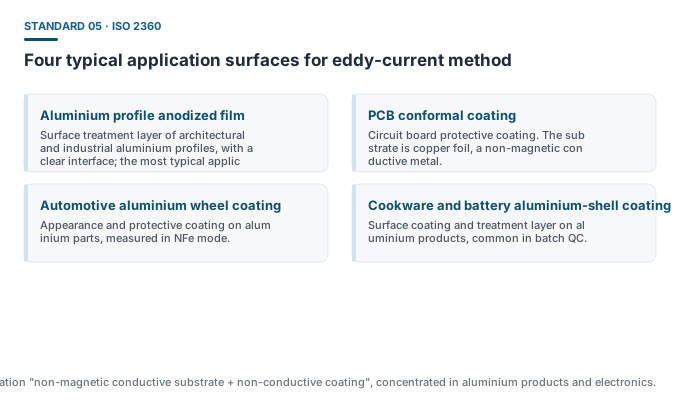
- Surface anodized film thickness of aluminium doors/windows and profiles;
- New-energy vehicle battery aluminium-shell coatings;
- Aerospace aluminium component coatings;
- Cookware aluminium-sheet coatings;
- Automotive aluminium wheel coatings;
- PCB conformal coating — corresponding to the target scenario of Dongru DR370A.
The biggest engineering variable: conductivity
Eddy-current strength depends on substrate conductivity, which varies far more actively in engineering materials than permeability:
| Variable | Effect |
|---|---|
| Different aluminium alloy grades | 6061, 6063, 7075 etc. have different conductivities and different reading baselines |
| Copper alloy composition changes | Brass and bronze differ markedly in conductivity |
| Heat treatment state | Solution, aging and annealing change conductivity |
| Substrate too thin | When thinner than the effective eddy-current penetration depth, the reading is low |
Comparison with ISO 2178
| ISO 2178:2016 | ISO 2360:2017 | |
|---|---|---|
| Substrate | Ferromagnetic metals | Non-magnetic conductive metals |
| Coating | Non-magnetic | Non-conductive |
| Principle | Magnetic induction (low freq) | Eddy current (> 1 MHz) |
| Chinese equivalent | GB/T 4956 | GB/T 4957 |
| Typical industry | Steel structures, industrial coating, automotive | Aluminium profiles, electronics, aluminium products |
Corresponding models in the Dongru product line
Pure eddy-current models are DR370A (0-1250 μm, PCB conformal coating / circuit board paint) and DR370B (0-500 μm, aluminium/copper oxide layer and ultra-thin paint). When you need to cover both steel and aluminium, choose the Fe/NFe dual-mode DR280A (0-1250 μm) or DR380A (0-2000 μm); the gauge switches principle automatically by substrate.
Common misconceptions
- ❌ “Eddy current can measure coatings on plastic parts” — plastic is non-conductive, eddy currents cannot form; use ultrasonic instead (ASTM D6132).
- ❌ “One calibration covers all aluminium parts” — grade and state changes both change conductivity and require re-calibration.
- ❌ “ISO 2360 is only for anodizing” — the standard covers all non-conductive coatings; paint, powder and plastic coatings apply equally.