
The bottom line
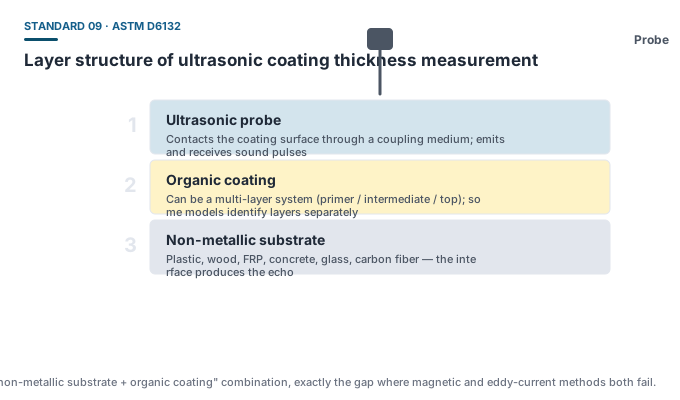
ASTM D6132 is a “filler piece” in the thickness-measurement standard system: magnetic covers steel, eddy current covers aluminium and copper, and the remaining non-metallic substrates — are taken over by D6132.
Key facts
| Item | Content |
|---|---|
| Number | ASTM D6132-13(2022) (issued 2013, reaffirmed 2022) |
| Principle | Ultrasonic pulse-echo |
| Applicable substrate | Plastic, wood, FRP, concrete, carbon fiber, glass |
| Measured object | Applied organic coatings |
| Layers resolvable | Up to 3 individual layers in the coating system |
| International equivalent | ISO 19397 |
| SSPC equivalent | SSPC-PA 9 |
Its boundary with magnetic/eddy-current standards
The three standards cover non-overlapping substrates, forming complete coverage:
| Substrate type | Applicable standard | Typical substrate |
|---|---|---|
| Ferromagnetic metals | ISO 2178 / ASTM D7091 | Carbon steel, cast iron, ferritic stainless steel |
| Non-magnetic conductive metals | ISO 2360 / ASTM D7091 | Aluminium, copper, brass, austenitic stainless steel |
| Non-metallic | ASTM D6132 / ISO 19397 | Concrete, wood, plastic, glass, FRP |
Typical application scenarios
- Wood furniture lacquer and wood-product painting;
- Plastic enclosure and injection-molded-part spraying;
- Yacht FRP hull coatings;
- Floor concrete topcoat and waterproof coating;
- Composite aerospace parts and wind-turbine-blade coatings.
Limitations and cautions
- Prefer magnetic/eddy-current for metal substrates: ultrasonic has good SNR on metal, but magnetic/eddy-current is simpler and more mature;
- Limited accuracy on ultra-thin coatings: when the coating is too thin the two interface echoes cannot be separated and accuracy drops;
- Coupling-sensitive: non-metallic substrates give weak echoes, and probe contact quality directly affects the reading;
- Substrate moisture state: the moisture content of concrete and wood changes the sound speed; record and keep measurement conditions consistent;
- Not for thick soft coatings: thick-film and polyurea ultra-thick soft coatings exceed the reliable range of portable gauges.
The value of layer resolution
D6132 mentions that ultrasonic coating gauges can resolve multiple individual layers in the coating system (e.g. primer + intermediate + top). This is valuable for quality traceability: if the total thickness passes but one layer is missed, only layer-by-layer measurement can find it. Dongru DR200A supports up to three-layer resolution.
Corresponding models in the Dongru product line
DR200A (40-1200 μm, ±(3%+3 μm)) targets coatings on concrete and cement-mortar surfaces; DR200B (18-1000 μm, ±(3%+3 μm)) with a small probe targets wood, plastic, glass and similar surfaces. The two share a main-unit platform and differ by probe, two variants under the same Listing.
Common misconceptions
- ❌ “Ultrasonic coating gauges can measure metal substrates” — technically yes, but metal substrates should prefer magnetic/eddy-current, which are more mature and simpler.
- ❌ “D6132 and D7091 can substitute for each other” — the substrate type and principle are completely different; not interchangeable.
- ❌ “Ultrasonic coating thickness and ultrasonic substrate thickness are the same” — the former measures coatings (micrometer level), the latter measures substrate wall thickness (millimeter level); the standards are D6132 and E797 respectively.