
The bottom line
PCB conformal coating measurement has exactly one principle option: eddy current. And it gives a valid reading only when the probe is over a copper trace — the most overlooked field limit in board measurement.
Why eddy current
Conformal coating protects boards from moisture, salt spray, mould and chemical corrosion; common materials are acrylic, polyurethane, silicone and parylene. They are insulators.
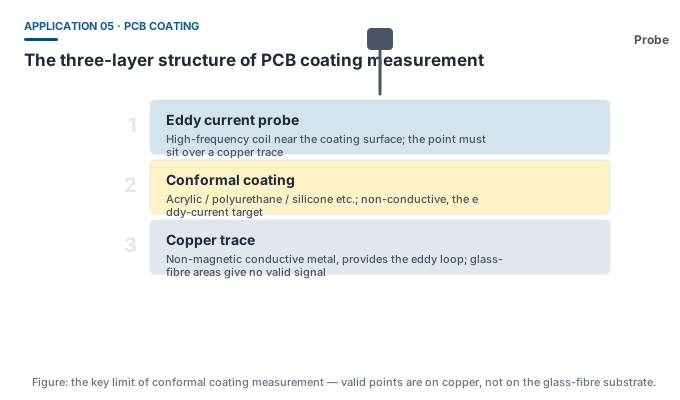
On the substrate side, the conductive layer of a board is copper foil — copper is a non-magnetic metal with good conductivity. The two conditions exactly fit the eddy current scope:
- Substrate must be “non-magnetic and conductive” -> copper foil qualifies;
- Coating must be “non-conductive” -> conformal coating qualifies;
- Magnetic method needs a ferromagnetic substrate -> copper fails, so magnetic method is useless here.
The biggest field trap: the point must be on copper
Eddy current needs a conductive substrate to form a loop. If the probe presses over a glass-fibre (FR-4) area, where there is neither conductivity nor a continuous metal layer, no eddy current forms and the reading is invalid or errors out.
So the correct flow is: first confirm the copper trace position with a magnifier or AOI image, then aim the probe at the trace. Common practice is to take several points on the same trace of the same board and fix those positions in the process document.
Thickness range and instrument choice
Conformal coatings are usually very thin; most process specs give a narrow allowed band rather than a wide range. Accordingly, pick a small-range, high-resolution eddy current gauge.
| Model | Principle | Range | Use case |
|---|---|---|---|
| DR370A | Eddy current | 0-1250 μm | PCB conformal coating, board paint — the typical conformal coating range |
| DR370B | Eddy current (digital oscillation) | 0-500 μm | Oxide layers and ultra-thin paint on aluminium/copper — smaller range for ultra-thin coatings |
| DR280A | Fe/NFe dual | 0-1250 μm | Mixed line handling both steel and copper/aluminium |
Process quality management points
- Fix the points: write point positions into the work instruction so batches stay comparable;
- Timing: confirm the coating is dry/cured per process; an uncured soft film gets imprinted by the probe;
- Multi-board sampling: sample a few boards per batch, several points per board, average and record the extremes;
- Keep records: conformal coating thickness is a key input to reliability verification; keep raw readings.
Common misconceptions
- “A magnetic gauge can measure it too” — copper is not magnetic, magnetic method gives no response.
- “Any position on the board works” — only over copper is valid; glass-fibre areas are meaningless.
- “Thicker coating means better protection” — too thick hurts heat dissipation and later assembly, and the thick layer carries high internal stress and cracks easily; control per process spec.