
The bottom line
ASTM D7091-22 answers “how to use the gauge compliantly”. It does not tell you how many micrometers of coating pass — that is SSPC-PA 2 or the project specification. The two documents are used together; neither is sufficient alone.
Document identity
| Item | Content |
|---|---|
| Number | ASTM D7091-22 |
| Latest edition | Published June 23, 2022 |
| Supersedes | D7091-21 / D7091-20 / D7091-13 / D7091-12 / D7091-05 |
| Document type | Standard Practice |
| Length | 7 pages |
| Issuing body | ASTM International · Subcommittee D01.23 |
| ICS class | 17.040.20 (Surface properties) |
| DOI | 10.1520/D7091-22 |
Full title: “Standard Practice for Nondestructive Measurement of Dry Film Thickness of Nonmagnetic Coatings Applied to Ferrous Metals and Nonmagnetic, Nonconductive Coatings Applied to Non-Ferrous Metals” — i.e. the nondestructive measurement of the dry film thickness of non-magnetic coatings on ferrous metals, and of non-magnetic, nonconductive coatings on non-ferrous metals.
Four key points in the scope clause
① Dry film only, not wet film
D7091 explicitly applies to the nondestructive measurement of dry film thickness (DFT). Deformable coatings (such as uncured wet film) are excluded from scope — a probe pressed into an uncured coating leaves an impression and changes the local thickness. Use a wet film comb or other method for wet film measurement.
② Two instrument classes
Within scope, coating thickness gauges are divided into Type 1 (magnetic pull-off) and Type 2 (electronic). SSPC-PA 2 references this classification directly in its clauses.
③ Used together with SSPC-PA 2
A D7091 clause states explicitly that a single-point measurement cannot represent the thickness of the entire coating system, and the measurement frequency is governed by SSPC-PA 2. One sentence sums up the division of labor —
ASTM D7091 is responsible for “measure accurately”; SSPC-PA 2 is responsible for “how many times to measure, and how to judge”.
④ Units and international trade
The standard treats SI units (μm, mm) as the standard, with the imperial units in parentheses for reference only. At the same time, the standard is developed in accordance with the principles of the WTO Technical Barriers to Trade (TBT) Committee, which means it has equivalency among WTO member states — a report issued by a Chinese or EU contractor under D7091 is generally accepted in the United States.
Three-step operation: why they cannot be mixed
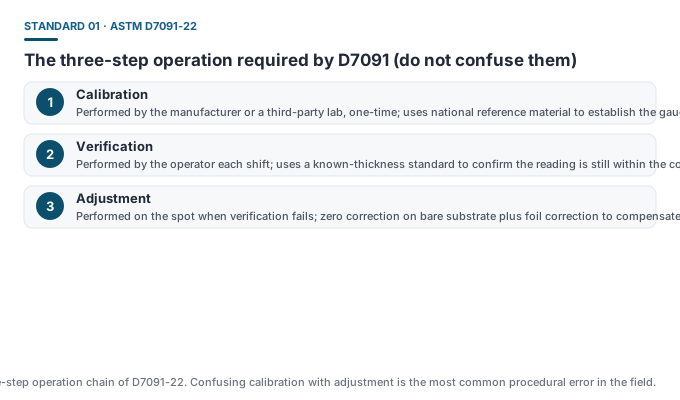
| Step | Performer | Frequency | What it does |
|---|---|---|---|
| Calibration | Manufacturer or third-party lab | One-time, recorded in certificate | Uses national reference material to establish the gauge zero and slope, and states the uncertainty |
| Verification | Operator | Start and end of each shift | Uses a known-thickness standard to confirm the reading is still within the controlled range |
| Adjustment | Operator | When verification fails or conditions change | Zero correction on bare substrate, then one- or two-point correction with a foil |
The reason these three steps cannot be mixed is that they address different errors: calibration addresses the instrument itself; verification addresses “is the instrument still in state now”; adjustment addresses “the substrate and geometry changed after moving to this workpiece”.
Guidance for procurement and product description
The clause structure of D7091 determines how compliant statements should be written:
- Instrument type statement:
Type 2 electronic gage per ASTM D7091; - Calibration statement: the calibration certificate must show traceability to a national metrology institute and give the measurement uncertainty;
- Operation statement: the instrument must support foil verification and zero adjustment, otherwise Verification and Adjustment cannot be performed.
All Dongru coating thickness gauges are Type 2 electronic instruments, covering Fe magnetic, NFe eddy-current and Fe/NFe dual-mode models.
Common misconceptions
- ❌ “D7091 sets the acceptable thickness” — it only specifies the measurement method, not the acceptance threshold.
- ❌ “Following the manufacturer manual is enough” — D7091 is positioned to supplement the manufacturer manual; both must be satisfied.
- ❌ “Calibrate once and use it long term” — calibration is the instrument state, but verification must be done every shift; long-term use also requires periodic re-calibration.