
The bottom line
ISO 2178:2016 is the most widely applied standard in industrial thickness measurement, because it covers the most common combination — steel substrate + paint or galvanized layer. Any non-magnetic coating on a ferromagnetic substrate can reference it.
Scope and principle
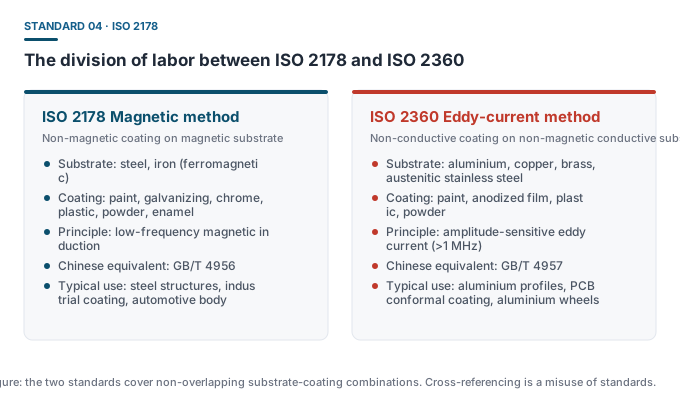
Full title: “Non-magnetic coatings on magnetic substrates — Measurement of coating thickness — Magnetic method”, specifying the nondestructive measurement method for non-magnetic coatings on magnetic substrates, including paint, galvanized layer, chrome layer, plastic coating, powder coating and enamel.
The principle is low-frequency magnetic induction: the probe generates a magnetic field that crosses the non-magnetic coating to reach the ferromagnetic substrate; the substrate changes the field-strength distribution, and the probe converts this change into coating thickness.
Key facts
| Item | Content |
|---|---|
| Number | ISO 2178:2016 (BS EN ISO 2178:2016 in parallel) |
| Supersedes | ISO 2178:1995 |
| Issuing body | ISO / TC 35 |
| Principle | Magnetic induction |
| Substrate | Ferromagnetic metals (steel, iron) |
| Coating | Non-magnetic (paint, galvanizing, chrome, plastic, powder, enamel) |
| Chinese equivalent | GB/T 4956 |
| US practice | ASTM D7091-22 |
Cross-references between standards
ISO 2178 references several related standards in its text; understanding these references helps judge whether a report is complete:
- ISO 19840 — measurement and acceptance of coatings on rough steel surfaces;
- ISO 2064 — terminology and definitions for thickness measurement;
- ISO 2361 — magnetic method for measuring nickel plating thickness (reverse application);
- ISO 2808 — general specification for paint film thickness determination;
- ISO 5725 — precision evaluation of measurement methods;
- ISO/IEC Guide 98-3 — expression of measurement uncertainty (GUM).
Reverse application: ISO 2361
The method of ISO 2178 can be used in reverse — measuring the thickness of a magnetic coating on a non-magnetic substrate, such as a nickel plating. But about 95% of industrial applications are still “non-magnetic coating on steel or iron”. Distinguish the direction when referencing the standard to avoid misattribution.
The easiest places to misuse
- Applying the steel-substrate standard to aluminium parts: aluminium is not ferromagnetic and is outside the scope of ISO 2178; use ISO 2360 instead;
- Treating an old national standard edition as current: the historical versions of GB/T 4956 correspond to ISO 2178:1995; check the current edition when referencing;
- Ignoring substrate differences: different steel grades have different permeability; the standard requires adjustment on the same-material substrate, a step that cannot be skipped;
- Measuring directly on rough surfaces: blasted surfaces need roughness correction per ISO 19840.
Corresponding models in the Dongru product line
Dongru Fe magnetic-mode models cover different ranges: DR120 (0-1500 μm), DR220 (0-2000 μm), DR260A (0-1250 μm), DR320 (0-2000 μm), DR360A (0-2000 μm, with zinc coating weight), DR5000S (0-5000 μm), DR6000A (0-6000 μm), DR9000A (0-10000 μm), DR15A (100 μm-15 mm). All of these can be used for non-magnetic coatings on ferromagnetic substrates per the ISO 2178 method.
Common misconceptions
- ❌ “ISO 2178 and ASTM D7091 are the same thing” — the former is a method standard (how to measure), the latter is a practice standard (how to use the gauge); both can be referenced.
- ❌ “Galvanized layer is not a non-magnetic coating” — zinc is a non-magnetic metal and is an explicitly listed coating type.
- ❌ “GB/T 4956 was developed independently” — it is an identical adoption of ISO 2178, an adoption relationship, not a separate system.