
The bottom line
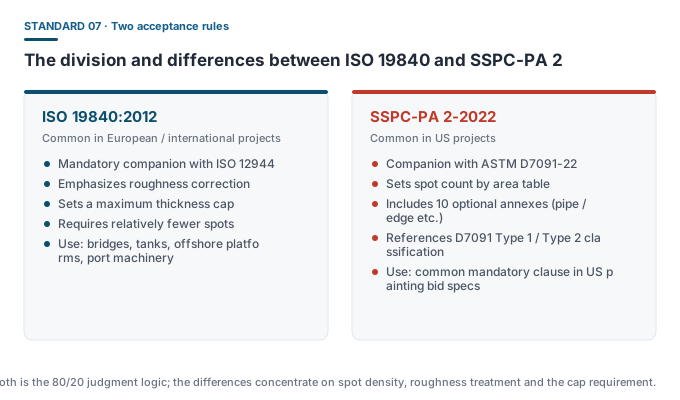
Facing the same question — “how do you judge a thick coating on a blasted steel structure acceptable” — the US and Europe each have a rule set. The judgment logic is similar but the details differ; only one set can be chosen in a single project.
What is ISO 19840:2012
Full title: “Paints and varnishes — Corrosion protection of steel structures by protective paint systems — Measurement of, and acceptance criteria for, the thickness of dry films on rough surfaces”.
It solves one specific problem: blasted steel has a rough surface (typical roughness Ra 50-100 μm), and ordinary gauges read high. The standard specifies how to compensate roughness, how to sample, and how to judge acceptance.
Key facts
| Item | ISO 19840:2012 | SSPC-PA 2-2022 |
|---|---|---|
| Issuing body | ISO / TC 35 | AMPP (formerly SSPC + NACE) |
| Companion standard | ISO 12944 (mandatory) | ASTM D7091-22 |
| Judgment rule | 80/20 rule | 80/20 rule |
| Spot count | Relatively fewer | By area table: ≤1000 ft² → 5 spots, max 25 spots |
| Roughness treatment | Requires correction, emphasizes baseline | Requires BMR correction |
| Thickness cap | Sets a maximum thickness cap | Focuses on lower bound, cap per project spec |
| Region | European / international projects | US painting work |
Why roughness must be corrected
The micro peaks and valleys of a blasted surface make the probe contact point sit on the peak tops, equivalent to adding an “air gap” outside the coating, and the reading is systematically high. The correction method uses bare substrate of the same roughness as the baseline (called Base Metal Reading, BMR, in SSPC-PA 2) and subtracts this deviation.
The place of ISO 12944
ISO 12944 is a complete set of specifications for anti-corrosion paint systems for steel structures (9 parts in total); ISO 19840 is its thickness-acceptance companion. ISO 12944 Part 2 defines atmospheric corrosivity categories C1 (very low) to C5 (very high industrial/marine) and the immersion/soil categories Im1-Im3; Part 5 specifies the coating system selection; Part 8 covers acceptance and references ISO 19840.
Practical selection advice
- The contract explicitly designates a standard → follow the contract; do not “add” the other set in the report;
- International projects → it is recommended to clarify which set to use at the contract negotiation stage and write it into the technical specification;
- Multiple parties inspecting one project → when each party uses its own instrument, the instrument differences should be compared and recorded in advance.
Corresponding models in the Dongru product line
Rough-surface coatings are usually thick; the corresponding Dongru models are DR280A (0-1250 μm, Fe/NFe dual mode), DR380A (0-2000 μm), DR5000S (0-5000 μm) and DR6000A (0-6000 μm). All of these support substrate zero adjustment and can perform BMR correction.
Common misconceptions
- ❌ “The two standards can substitute for each other” — the frameworks are similar but the spot count and cap requirements differ; mixing causes disputes.
- ❌ “Roughness correction can be made up later with an average” — correction must be measured on bare substrate of the same roughness, not calculated afterwards.
- ❌ “ISO 19840 only applies to European projects” — it is an international standard and can be referenced by any project using the ISO system.