
The bottom line
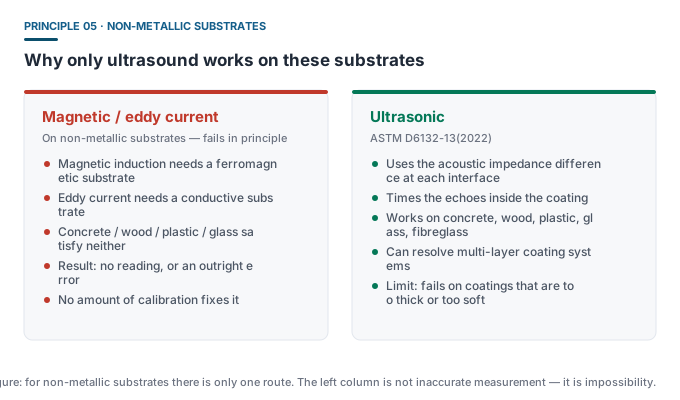
When the substrate is neither magnetic nor conductive, magnetic induction and eddy current fail together. The only portable option is ultrasound: it exploits the acoustic impedance difference between coating and substrate to measure the coating itself. The governing standard is ASTM D6132-13(2022).
Why the first two principles cannot work
Magnetic induction requires a magnetisable substrate; eddy current requires a conductive one. Concrete (cement paste plus aggregate), wood (cellulose), plastic (polymer) and glass (amorphous silicate) are neither ferromagnetic nor conductive, so both principles lack any physical basis.
This is a different situation from insufficient accuracy. On a non-metallic substrate, a magnetic or eddy current gauge does not read low or high — it has no usable signal at all.
What ultrasound actually does
- The probe is pressed onto the coating surface through a coupling medium and fires an ultrasonic pulse;
- Echoes are generated at the coating/air interface and at the coating/substrate interface;
- The interval Δt between those echoes and the coating velocity c determine the thickness (thickness = c × Δt ÷ 2);
- Because the acoustic impedance difference is pronounced, the interface echoes can be separated, which is how the gauge sees the coating alone.
What it can and cannot measure
| Substrate | Usable | Dongru model | Note |
|---|---|---|---|
| Concrete, cement mortar | Yes | DR200A (40-1200 μm, ±(3%+3 μm)) | Flooring and waterproofing coatings; resolves up to three layers |
| Wood, plastic, glass | Yes | DR200B (18-1000 μm, ±(3%+3 μm)) | Furniture lacquer, moulded parts, glass coatings; small probe follows curved surfaces |
| Fibreglass / composites | Yes | Verify the part and thickness first | Confirm acoustic impedance match; a trial measurement is recommended |
| Heavy-build / polyurea and other thick soft coatings | No | — | Beyond the reliable window of portable ultrasonic coating gauges; no claim is made |
The value of layer-by-layer measurement
Many non-metallic coating systems are multi-layer (primer, intermediate, topcoat). Ordinary thickness measurement gives only the total; layer resolution reads each coat separately, which is how you detect a missing or over-thick individual layer. Dongru DR200A resolves up to three layers, an advanced capability in this product class.
Standards discipline
This category may only cite ASTM D6132-13(2022), the ultrasonic entry in ISO 2808, and SSPC-PA 9. It belongs to a different substrate family and a different principle from the steel-substrate SSPC-PA 2 / ASTM D7091 pairing, and the two must not be cited interchangeably.
- Magnetic induction on steel → SSPC-PA 2 / ASTM D7091 / ISO 2178;
- Eddy current on non-ferrous metal → ASTM D7091 / ISO 2360;
- Ultrasonic on non-metallic substrates → ASTM D6132-13(2022) / SSPC-PA 9 / ISO 2808 Method 10.
Common misconceptions
- “Put a steel plate behind the wood and measure on top of it” — that measures the coating on your steel plate, not on the part.
- “Ultrasonic coating measurement and ultrasonic wall thickness measurement are the same thing” — one measures a coating (tens to a thousand microns), the other a substrate wall (millimetres). Probe frequency, algorithm and standards all differ.
- “Moisture content in concrete does not affect the reading” — moisture changes sound velocity. Record the condition and keep measurement conditions consistent.