
The bottom line
There is no second choice for coating measurement on non-metallic substrates: ultrasonic only. This judgement precedes any instrument selection — because magnetic and eddy current both fail here.
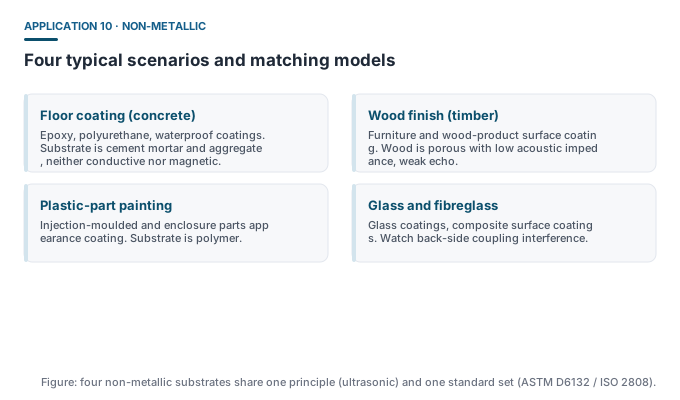
Which scenarios fall in this group
| Scenario | Substrate | Coating system | Dongru model |
|---|---|---|---|
| Floor coating | Concrete, cement mortar | Epoxy, polyurethane, waterproof | DR200A (40-1200 μm) |
| Wood finish | Wood | Primer + topcoat, often multi-layer | DR200B (18-1000 μm) |
| Plastic-part painting | ABS, PC, PP etc. | Appearance paint, UV coating | DR200B (small probe fits curves) |
| Glass coating | Glass | Functional, decorative coating | DR200B |
Standards and citation discipline
The standard basis for this group is ASTM D6132-13(2022) (standard test method for non-destructive measurement of applied organic coatings using an ultrasonic coating thickness gauge) and the ultrasonic clause of ISO 2808:2019; in the SSPC system it corresponds to SSPC-PA 9.
Where it is harder than on metal
- Substrate acoustic properties vary widely: concrete has aggregate and pores, wood has grain and rings; velocity and attenuation differ;
- Weak echo: low-impedance substrates give small interface echoes, demanding more from probe contact and coupling;
- Uneven surface: rough concrete and wood grain reduce probe contact area;
- Moisture effect: concrete and wood moisture state changes velocity; record and keep measurement conditions consistent.
Accordingly, industry practice for this group usually requires more spots, recorded environmental conditions, and repeated measurement at the same member averaged.
Layer measurement: the advanced capability on non-metallic substrates
Wood finishes and floor coatings are often multi-layer (primer + midcoat + topcoat). A normal gauge gives only total thickness, but a layer-capable gauge can read layer by layer, to judge whether a layer was missed. Dongru DR200A supports up to three-layer measurement.
State the capability boundary clearly
DR200A upper range is 1200 μm (about 47 mil), DR200B is 1000 μm (about 39 mil). That covers routine floor coatings, wood finishes and plastic-part painting, but not thick-film high-build coatings and polyurea ultra-thick soft coatings. State this boundary in external descriptions.
Common misconceptions
- “Slip a steel plate under it and use a magnetic gauge” — you measure the coating on the steel plate, unrelated to the part.
- “Ultrasonic thickness gauge and ultrasonic coating gauge are the same” — the former measures metal wall (millimetres), the latter coating thickness (micrometres); probe, algorithm and standard all differ.
- “Concrete moisture does not affect measurement” — moisture changes velocity and biases the reading; record and unify conditions.