
The bottom line
The physics of measuring zinc coating thickness is no different from ordinary paint — zinc is a non-magnetic coating on steel, so it is magnetic method. The only industry difference is expression: galvanizing talks weight, the gauge talks micrometres.
Why the galvanizing industry uses weight
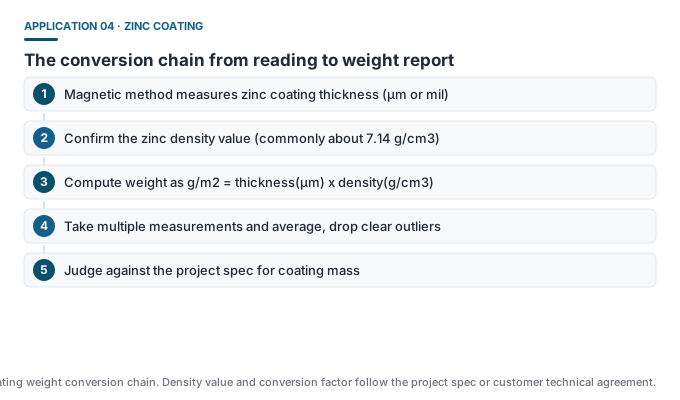
Hot-dip galvanizing acceptance is traditionally expressed as zinc mass per unit area (g/m2 or oz/ft2), because it maps directly to “how much zinc was consumed”, tying to material cost and corrosion life. A length-based thickness is what the gauge reads directly. The two meet through a density conversion:
g/m2 ~= thickness(μm) x density(g/cm3). At zinc density about 7.14 g/cm3, 1 μm zinc ~ 7.1 g/m2.
Method and standards
| Item | Content |
|---|---|
| Principle | Magnetic induction (magnetic method); zinc is non-magnetic coating, steel is ferromagnetic substrate |
| US standards | ASTM B499 (magnetic method for coating thickness), ASTM E376 (coating thickness measurement practice) |
| International standards | ISO 2178:2016; operating procedure ASTM D7091-22 |
| Instrument type | Type 2 electronic as defined by ASTM D7091 |
Measurement difficulties on hot-dip parts
- Rough surface: hot-dip surfaces show spangle and zinc nodules; local thickness varies a lot, so add spots and average;
- Thicker edges: zinc pools at edges and lower ends; record edge spots separately, do not mix into the area average;
- Large parts: long members (tower steel, guardrail posts) need spots spread along the length;
- Internal threads: coating on threads affects fit, so evaluate per drawing.
Accordingly, galvanizing acceptance usually sets both a minimum and an average requirement, plus spot count and distribution.
The matching Dongru models
DR360A (0-2000 μm, +/- (1%-3%)H+1.5 μm, built-in Li-ion) targets the zinc-weight conversion scenario and computes coating mass. If you also need aluminium and steel, choose dual-mode DR280A; routine QA on a pure hot-dip line can also use DR260A (0-1250 μm) or DR320 (0-2000 μm).
Common misconceptions
- “The gauge shows weight directly, no conversion” — some models display weight, but it is still a density conversion; a wrong density gives a wrong result.
- “Thicker zinc is always better” — too thick makes the coating brittle and prone to flaking, and hurts thread fit; specs usually set both limits.
- “One spot represents the whole batch” — hot-dip non-uniformity is far higher than spray coating; you must sample at multiple points.