
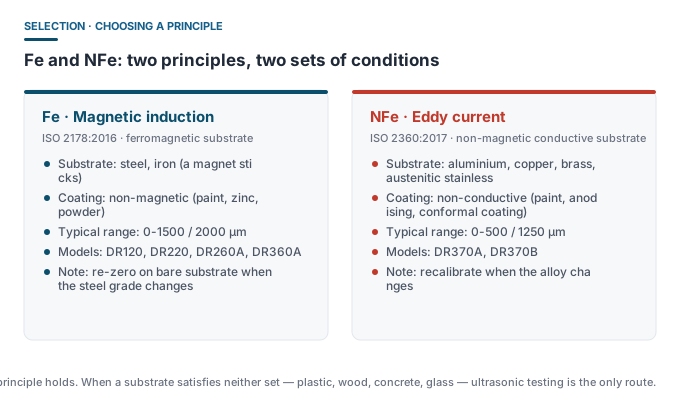
The bottom line
A thickness gauge is not a universal instrument. Choosing the wrong principle does not give you a slightly high or low number — it gives you a meaningless number. The order is always: substrate, then coating, then instrument.
Step one: is the substrate ferromagnetic?
The most practical field method is to carry a magnet:
- The magnet sticks → ferromagnetic substrate (carbon steel, low-alloy steel, cast iron, ferritic stainless steel) → magnetic induction, Fe;
- The magnet does not stick, but the part is metal → non-magnetic conductive substrate (aluminium, copper, brass, austenitic stainless steel) → eddy current, NFe;
- Neither metal nor conductive → plastic, wood, glass, concrete, fibreglass → both magnetic induction and eddy current fail, and only ultrasonic works.
Step two: is the coating conductive?
Both principles require the coating to block a physical quantity: magnetic induction needs a non-magnetic coating, eddy current needs a non-conductive one. The common non-magnetic, non-conductive coatings are paint, varnish, powder coating, anodising, conformal coating, plastic coatings and enamel.
If the coating itself conducts — some conductive paints, thermally sprayed metal layers — both methods fail, and you need a different technique such as coulometric or X-ray methods.
Dual mode: two purchases rolled into one
For contractors who handle both steel and aluminium parts, a dual-mode gauge is the efficiency choice. Dongru Fe/NFe models include DR-A5 (0-2000 μm, automatic recognition), DR130 (0-1500 μm), DR230 (0-2000 μm), DR280A (0-1250 μm), DR330 (0-2000 μm), DR3000 (0-3000 μm) and DR380A (0-2000 μm).
A dual-mode probe decides by first applying a magnetic field: a response means magnetic induction, no response means it switches to eddy current. That is also why it fails on non-metallic substrates — by design, that combination lies outside both principles.
Substrate families and the models that cover them
| Substrate | Typical materials | Usable principle | Dongru models |
|---|---|---|---|
| Ferromagnetic metal | Carbon steel, cast iron, ferritic stainless steel | Magnetic induction (Fe) | DR120 / DR220 / DR260A / DR320 / DR360A / DR5000S / DR6000A / DR9000A / DR15A |
| Non-magnetic conductive metal | Aluminium, copper, brass, austenitic stainless steel | Eddy current (NFe) | DR370A / DR370B |
| Both in play | — | Fe + NFe dual mode | DR-A5 / DR130 / DR230 / DR280A / DR330 / DR3000 / DR380A |
| Non-metallic | Concrete, wood, plastic, glass, fibreglass | Ultrasonic | DR200A / DR200B |
The one-line rule
Magnet sticks → Fe. Magnet does not stick but the part conducts → NFe. Does not conduct → ultrasonic.
Common misconceptions
- “A dual-mode gauge is less accurate than a single-principle one” — accuracy depends on the probe and the calibration, not on integration. What a dual-mode gauge costs you is range at the top end and purchase price, not reading quality.
- “Buy the magnetic model now and add an eddy current one later” — for a contractor who must accept work across substrates, two instruments cost more in calibration and record-keeping than one dual-mode gauge.
- “A dual-mode gauge will limp through non-metallic substrates” — it will not. There is no response in principle.