
The bottom line
The same thickness is expressed two ways around the world — this is not confusion but a difference in convention. For the US market, speak in mil; for standards documents, record in μm.
Conversion relationships
| Unit | Relationship | Note |
|---|---|---|
| mil | 1 mil = 25.4 μm = 0.001 inch | Common in US engineering |
| μm (micrometre) | SI unit, used in standards text | The international basis |
| mm (millimetre) | 1 mm = 1000 μm | Common for base wall thickness |
| inch | 1 inch = 1000 mil | North American length basis |
Why standards use μm and the field uses mil
ASTM D7091-22 states clearly in its units clause: SI units (μm, mm) are the standard, and imperial units in parentheses are for reference only and are not considered the standard. This is common practice across the international standards system.
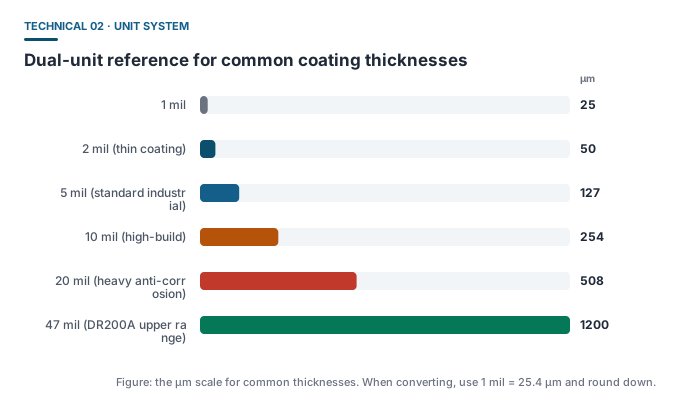
But the reality on US job sites is that coating specifications, paint technical data sheets and communication between contractors all use mil. When a coating inspector says “this part calls for 5 mil”, both sides understand immediately, without converting to 127 μm.
On paper, follow the standard; in conversation, follow habit — that is why the two unit systems coexist for the long term.
Common thickness reference table
| mil | μm | Typical scenario |
|---|---|---|
| 0.5-1 mil | 12-25 μm | Thin anodising, electronic coatings |
| 1-2 mil | 25-50 μm | Thin coatings, some automotive paint |
| 2-5 mil | 51-127 μm | Standard industrial coatings, full-body automotive film |
| 5-10 mil | 127-254 μm | High-build coatings, flooring |
| 10-20 mil | 254-508 μm | Heavy anti-corrosion systems |
| 20-50 mil | 508-1270 μm | Thick anti-corrosion layers, some fireproofing |
Requirements for products and documentation
- Instruments should support bidirectional μm / mil switching, with range and accuracy converted together on switch;
- For the US market, titles, bullets and descriptions should use mil as the primary unit, with μm as a parenthetical supplement;
- Giving both units in reports and certificates avoids ambiguity, but the conversion method must be stated;
- Converted values should be marked with the rounding rule to avoid the misleading impression of a “larger range”.
Common misconceptions
- “mil is short for millimetre” — mil is one-thousandth of an inch (milli-inch), completely different from mm (millimetre); confusing them causes a 25× error.
- “μm is more precise so it should be preferred” — it depends on the audience. Using μm with US contractors adds communication cost.
- “The rounding direction does not matter” — over-reporting a range carries compliance risk and rounding should always be down.