
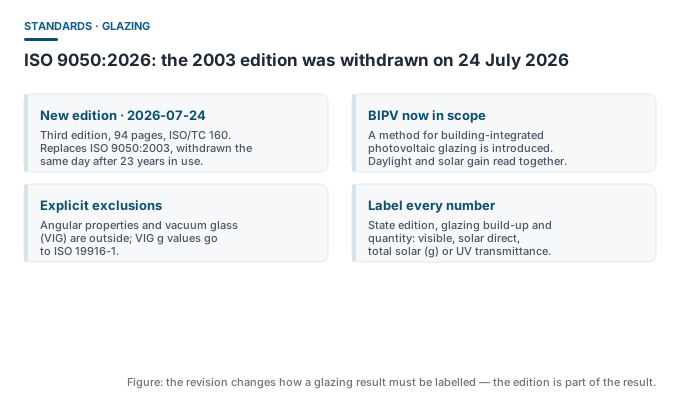
Quick answer: On 24 July 2026 ISO published ISO 9050:2026, “Glass in building — Determination of luminous and solar characteristics of glazing” (third edition, 94 pages, ISO/TC 160). The 2003 edition was withdrawn on the same day. If a test report simply says “according to ISO 9050”, it is now ambiguous: two editions with different scopes have carried that number. The practical change is not that every old reading is wrong, but that every number needs its edition, its glazing build-up and its quantity name attached to it.
What the new edition actually is
ISO 9050 is a calculation standard, not an instrument standard. It defines how to derive the luminous and solar characteristics of glazing from spectral data, so the results can feed lighting, heating and cooling calculations and allow different glazing products to be compared. The 2026 edition covers conventional glazing as well as absorbing or reflecting solar-control glazing, in vertical or horizontal apertures. Formulae are given for single, double and triple glazing, with a matrix method as an alternative calculation route.
The 2003 edition was a 27-page document with a longer, more literal title listing light transmittance, solar direct transmittance, total solar energy transmittance and ultraviolet transmittance. The new title is deliberately broader. Anyone maintaining a library of supplier datasheets should expect the two generations of documents to use different names for closely related quantities.
BIPV is now inside the scope
The most consequential addition is stated plainly in the abstract: the 2026 edition “introduces a method to determine the luminous and solar properties of building-integrated photovoltaic (BIPV) glazing”. BIPV glazing is both a power-generating component and part of the building envelope, so daylight, solar gain and the optical behaviour of the active layer have to be described together. Under the older edition there was no dedicated method for that combination, which is one reason the revision was started at the end of 2024.
What is explicitly excluded
| Excluded item | What the standard says | Why it matters in a report |
|---|---|---|
| Angular properties | Angular light and solar properties of glass in building are outside the scope. | A single normal-incidence transmittance value does not describe off-angle behaviour. |
| Vacuum insulating glass | VIG is excluded; for its g value the standard points to ISO 19916-1. | Do not cite ISO 9050 as the basis for a VIG g value. |
| Materials transmitting in the 5–50 µm region | Transparent materials with significant transmission of ambient-temperature radiation, such as certain plastics, are excepted. | Some plastic glazing and films need a different treatment of secondary heat transfer. |
Materials that scatter incident radiation are a separate case: the 2026 edition treats them as conventional transparent materials only under certain conditions set out in clause 5.3. A diffusing or textured sample therefore needs its eligibility checked before a total transmittance figure is compared with that of clear glass. When scattering is significant, haze measurement quantifies a different quantity altogether — the wide-angle scattered share of transmitted light.
What changes for reports you already hold
- Name the edition and the date. “ISO 9050” without a year is no longer sufficient for a new report. Older reports stay valid as historical records but should not be silently reissued under the new number.
- Describe the build-up. Single, double or triple glazing, layer order and coating position are inputs to the calculation. Two datasheets quoting the same visible transmittance for different build-ups are not comparable.
- Name the quantity, not just “transmittance”. Luminous (visible) transmittance, solar direct transmittance, total solar energy transmittance (g / TSET) and ultraviolet transmittance are different outputs with different weighting functions. The three-band overview explains why a number without its band is close to meaningless.
- Keep generations separate in comparisons. Derived quantities such as shading coefficient or total solar energy transmittance are sensitive to the calculation rules behind them. Do not place a 2003-edition value and a 2026-edition value in the same trend line without saying so.
A calculation standard is not a field meter
ISO 9050 takes spectral transmittance and reflectance as inputs, normally measured on a laboratory spectrophotometer with an integrating sphere across the solar range. A portable transmittance meter used on site measures a defined band at a defined geometry — useful for checking a window film or a production batch, but not a g value, a shading coefficient or an angular property. Conflating the two is the most common source of inflated claims in window-film marketing. If you are choosing a handheld or benchtop instrument, the transmittance meter selection guide separates the instrument classes; the optical measurement overview explains how transmittance, haze and gloss differ as measurands.
Common misreadings of the news
- “The new edition invalidates all old measurements” — the spectral data are still data; what changed is the calculation framework and the labelling obligation.
- “The standard now covers every glass product” — VIG and angular properties are explicitly outside it.
- “A visible transmittance reading is enough for a solar-control claim” — solar characteristics require the full spectral treatment.
- “Hydrophobic or diffusing films are covered the same way” — light-scattering materials are handled only under the conditions in clause 5.3.
For procurement and compliance, the shortest reliable habit is to ask every supplier which edition, which glazing build-up and which quantity their number refers to. That question costs nothing and resolves most disagreements before they reach a test lab.
Sources
- ISO 9050:2026 — official ISO catalogue entry (scope, edition, publication date)
- ISO 9050:2003 — official ISO catalogue entry (withdrawn 24 July 2026)
Related instruments: DONGRU DR-W300 Haze Meter · DONGRU DR60A Portable Gloss Meter · Request a quote