
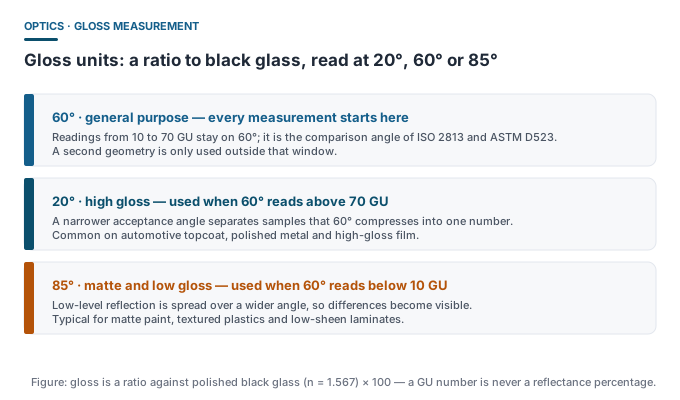
Quick answer: A gloss value is the ratio of light a surface reflects in the specular direction to the light a polished black glass reference (refractive index 1.567) reflects at the same angle, multiplied by 100 and expressed in gloss units (GU). The measurement angle — 20°, 60° or 85° from the surface normal — is part of the result, so a number without its geometry means nothing. Start every sample at 60°; switch to 20° when the reading is above 70 GU, or to 85° when it is below 10 GU.
GU is a ratio, not a reflectance percentage
ISO 2813:2014 defines the gloss value this way and explicitly states that gloss values must not be interpreted or expressed as “% reflection”. The polished black glass standard is assigned 100 GU at all three geometries; everything else is compared against it. A reading of 70 GU at 60° therefore does not mean “70 % of the light is reflected” — it means the surface reflects 70 % as much specular light as the reference glass at that angle.
Three geometries, one starting rule
| Geometry | Suits | When to use it |
|---|---|---|
| 60° | Semi-gloss, general purpose | Always measure first. Readings between 10 and 70 GU stay at 60°. |
| 20° | High gloss | When the 60° reading exceeds 70 GU — better resolution among glossy samples. |
| 85° | Matte and low gloss | When the 60° reading falls below 10 GU — better discrimination at the low end. |
The rule is the one both ISO 2813 and ASTM D523 describe: 60° is the universal reference, and the 60° result tells you whether a second geometry gives more resolution. Reporting only “gloss 92” hides the most important part of the result.
One surface, three different numbers
The gloss scale is non-linear across geometries. ISO 2813 gives a worked example: a coating that a trained observer classes at the glossiest visual grade reads about 35 GU at 20°, 70 GU at 60° and 95 GU at 85°. The same surface, three numbers — none of them wrong. This is why values from different angles are never comparable, and why a specification must name the geometry along with the limit.
How the instrument turns light into GU
- The meter illuminates the surface at the stated angle and measures the reflected light inside a narrow acceptance field around the specular direction;
- Light scattered outside that field — by roughness, texture or a matte binder — is not counted, which is why a matte surface can reflect plenty of light and still read low gloss;
- Source and receptor apertures, spectral adaptation and the reference refractive index are all part of the geometry definition;
- Values on coatings are reported rounded to the nearest integer, so “70 GU” is already a rounded statement.
ISO 2813 addresses non-textured coatings on flat, opaque substrates. Curved, textured or transparent samples need care: a comparative reading may still be possible, but the standard notes that it is not guaranteed to match visual gloss perception.
What a gloss reading does not tell you
Gloss counts only the specular component. It does not describe orange peel, distinctness of image (DOI) or the milky scatter that haze measurement quantifies — a panel can read high GU and still show visible texture. Nor does a low gloss number prove a surface is smooth; it proves little light leaves in the specular direction.
Calibration and reporting
- Check the instrument against its certified reference standard (black glass or a traceable working tile) before a series of measurements, and after any handling shock;
- Record the geometry, the standard and edition, the instrument and the surface condition;
- Keep samples clean and handle reference tiles by their edges; fingerprints read as gloss;
- Store readings with the batch or part ID, the way an inspection record stores thickness data.
Common misconceptions
- “GU is a percentage of reflected light” — it is a ratio to a reference glass, in gloss units only;
- “Higher GU is always better” — gloss is an appearance target set by the product specification, not a quality ranking;
- “Any angle works” — outside the 10–70 GU window the 60° scale compresses and small differences vanish;
- “Gloss measures smoothness” — it measures specular reflection at one geometry; roughness, DOI and haze are separate quantities.
To match an instrument to your surfaces, see the gloss meter selection guide; for how gloss relates to transmittance and haze, see the optical measurement overview.
Technical sources
Related instruments: DONGRU DR60A Portable Gloss Meter · DONGRU DR-W300 Haze Meter · Request a quote