
The bottom line
Standard-citation errors usually take two forms: wrong standard family (applying a steel-substrate standard to a non-metallic substrate) and missing the revision year. The first hurts conclusion validity; the second hurts professionalism.
| Substrate | Method standard | Operating practice | Acceptance procedure |
|---|---|---|---|
| Steel / iron (magnetic) | ISO 2178:2016 / GB/T 4956 | ASTM D7091-22 | SSPC-PA 2-2022 or ISO 19840:2012 |
| Aluminium / copper / austenitic stainless (eddy) | ISO 2360:2017 / GB/T 4957 | ASTM D7091-22 | As contracted |
| Non-metallic (ultrasonic) | ASTM D6132-13(2022) / ISO 19397 | Manufacturer practice | SSPC-PA 9 or as contracted |
| Substrate wall (ultrasonic) | ASTM E797 / ISO 16809 | Manufacturer practice | Per equipment inspection spec |
Two-step locating method
Facing an unfamiliar project spec or an unknown standard system, locate in two steps — substrate first, purpose second — and you will rarely cite the wrong document.
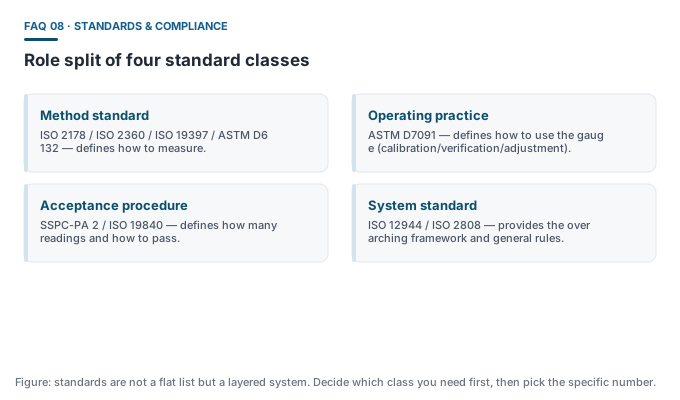
- Step 1 — lock the family by substrate — ferromagnetic, non-magnetic conductive and non-metallic families do not overlap; picking the wrong family means the whole measurement conclusion does not apply to the project.
- Step 2 — lock the document type by purpose — the method standard governs “how to measure,” the operating practice governs “how to use the gauge,” the acceptance procedure governs “how many readings, how to pass.” The three solve different problems and cannot substitute for each other.
- Write the revision year when citing, and pick one judgement system per project — forms like ASTM D7091-22 and ISO 2178:2016 avoid ambiguity; mixing SSPC-PA 2 and ISO 19840 rules causes conflicts in reading count and acceptance conclusion.
Once the two steps are set, the rest is checking specific clause numbers and revision years. Tabulating this into a bid or inspection document noticeably cuts later clarification rounds.