
The bottom line
Environmental factors do not “break” the gauge, but they strip the data of comparability. Once comparability is lost, both the 80/20 judgement and trend analysis become meaningless.
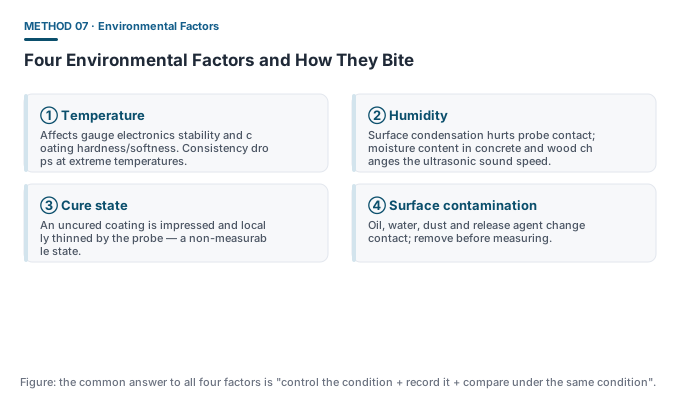
① Temperature
Effect on the gauge
Electronic component behaviour drifts with temperature, and the probe coil impedance is temperature-sensitive too. After a large temperature swing (e.g. moving the gauge from a cold truck into a warm room) let it equilibrate before use, so a reading drift is not mistaken for a fault.
Effect on the coating
At low temperature the coating is harder and more brittle; at high temperature it is softer. This has limited effect on magnetic methods but a clearer one on ultrasonics — the sound speed changes with temperature.
Practical advice
- Let the gauge equilibrate with the ambient temperature before measuring;
- Avoid measuring on sun-heated equipment surfaces (local temperature can far exceed ambient);
- Record the ambient temperature for cross-batch comparison.
② Humidity and moisture content
- Surface condensation: a water film changes probe contact, especially on metal;
- Concrete moisture: water’s sound speed is far higher than concrete, so moisture changes shift the ultrasonic reading markedly;
- Wood moisture: also affects sound speed and attenuation;
- Advice: confirm the surface is dry before measuring, record humidity and material state, and re-measure under the same conditions.
③ Coating cure state
ASTM D7091 explicitly excludes easily deformed coatings — pressing the probe into an uncured coating leaves an impression and changes the local thickness. Judge cure state from the coating technical data sheet conditions (temperature, time, optional forced-drying requirement), not by feel.
④ Surface contamination
| Contaminant | Effect | Treatment |
|---|---|---|
| Oil, release agent | Changes probe contact and the magnetic circuit | Wipe with solvent, then dry |
| Water, condensation | Forms an extra medium layer | Wipe dry or wait for drying |
| Dust, grit | Makes the probe float | Blow off with compressed air or brush away |
| Loose old paint | Reading includes the old paint thickness | Handle per project rules, or switch to through-coat mode (ultrasonic) |
Which environmental data to record
The acceptance record should include: ambient temperature, relative humidity, measurement time, workpiece surface state (rough or not, dry or not), coating application completion time and cure conditions. This keeps the data explainable afterwards.
Common misconceptions
- ❌ “Just measure right after spraying, it is convenient” — an uncured reading does not represent the final DFT and damages the coating surface.
- ❌ “Temperature effect can be ignored” — under large temperature swings, neither gauge drift nor sound-speed change can be ignored.
- ❌ “Data from different times can be compared directly” — if the conditions differ, confirm comparability before comparing.