
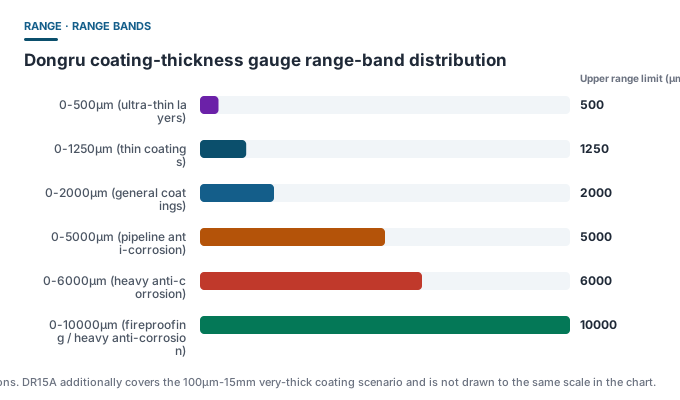
The bottom line
The basis for range selection is the actual distribution of thickness, not the “largest possible value”. Selecting a range by an upper limit you will never reach costs you overall accuracy.
Scenarios mapped to each band
| Range band | Typical application | Dongru model |
|---|---|---|
| 0-500μm | Ultra-thin paint, oxide layers on aluminum and copper | DR370B |
| 0-1250μm | Thin coatings, anodising, PCB conformal coatings, automotive paint | DR260A / DR280A / DR370A |
| 0-1500μm | Automotive paint, general coatings | DR120 / DR130 |
| 0-2000μm | General industrial coatings, galvanising, automotive body panels | DR220 / DR230 / DR320 / DR330 / DR360A / DR380A |
| 0-3000μm | High-build coatings, thicker anti-corrosion layers | DR3000 |
| 0-5000μm | Pipeline anti-corrosion, thick coatings | DR5000S |
| 0-6000μm | Heavy anti-corrosion, thick anti-corrosion layers, some fireproofing | DR6000A |
| 0-10000μm | Very-wide-range fireproofing and anti-corrosion | DR9000A |
| 100μm-15mm | Intumescent fireproofing and other very thick coatings | DR15A |
Why “running at the limit” is a bad habit
Accuracy expressions carry a proportional term, for example the 3%H in ±(1%~3%)H+1.5μm grows linearly with the reading. The closer the reading to the upper range limit, the larger the absolute tolerance. Beyond that, near the limit the probe output signal approaches saturation and non-linear error begins to appear.
How to determine the range you actually need
- Profile your measured thickness data over the past period (at least a few dozen samples);
- Take the 80th percentile as the “typical upper thickness”, not the maximum;
- Make that value fall in the 50%-80% band of the chosen range;
- Keep a plan for extreme values — measure them with another wide-range gauge rather than widening the usual band.
The relationship between units and range
Range switching is often accompanied by unit switching. US engineering practice favours mil (thousandths of an inch), 1 mil = 25.4 μm. When selecting, confirm the gauge supports μm / mil dual-unit switching, and watch the rounding direction in conversion — when stating a range outward you should round down, never overstate.
Special considerations for wide-range scenarios
- Rougher surfaces on thick coatings: wide-range scenarios (fireproofing, heavy anti-corrosion) have high surface roughness and require base-metal zero correction;
- Possible internal layering: multi-pass thick coatings may have inter-layer interfaces, giving larger reading fluctuation, so increase the number of measurement points;
- Probe form: thick coatings often use a large-diameter probe for stability, but large probes adapt poorly to curved surfaces.
Common misconceptions
- ❌ “Buy big, not small, it measures anything anyway” — covering a small-range scenario with a wide-range gauge wastes accuracy noticeably.
- ❌ “Over-range is just slightly inaccurate” — past the upper limit the reading enters a non-linear region and the number is worthless.
- ❌ “The lower range limit does not matter” — the lower limit is equally critical; for example a 0.55mm ultrasonic lower limit decides whether thin walls can be measured.
Frequently asked questions
How do I choose the right measuring range?
Follow one principle: match. Keep your typical thickness in the middle of the range. Too large a range wastes accuracy; too small a range simply will not work.
Is a wider range always better?
No. A wide range does not mean uniform accuracy across it, and buying a wide-range model for a thick-coating job you do a few times a year costs you a larger absolute tolerance on your daily thin coatings.
Does a wide range mean uniform accuracy everywhere?
No. The same gauge has different allowable deviation near the lower limit versus near the upper limit. Range width is not a measure of capability.
What does the lower limit decide?
For an ultrasonic gauge, the lower limit decides whether it can measure thin walls. For example, the DR89S’s 0.15 mm lower limit is exactly why it handles ultra-thin automotive sheet.
What should I confirm together with the range?
The unit expression (mil or μm). Confirming range together with the unit avoids the most common rework in range selection.
Related instruments: DONGRU DR-A5 Automotive Paint Thickness Gauge · DONGRU DR9000A Fire-Resistant Coating Thickness Gauge · Request a quote