
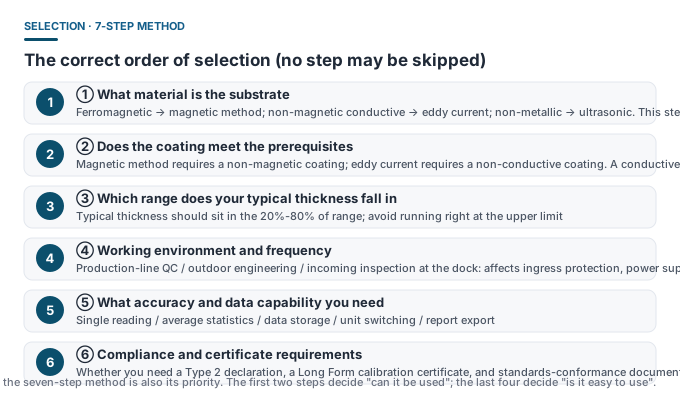
The bottom line
The most common way to fail at selection is not buying a cheap instrument, but choosing the wrong principle. No matter how accurate a magnetic gauge is, its readings on aluminium are still invalid.
Step 1: Substrate material
A magnet settles most of the question:
| Substrate | Magnet response | Usable principle | Dongru model examples |
|---|---|---|---|
| Carbon steel, cast iron, ferritic stainless steel | Attracts | Magnetic method (Fe) | DR120 / DR220 / DR260A / DR320 / DR360A |
| Aluminium, copper, brass, austenitic stainless steel | No attraction (conductive) | Eddy current (NFe) | DR370A / DR370B |
| Mixed steel-aluminium line | Partial attraction | Fe/NFe dual | DR-A5 / DR130 / DR230 / DR280A / DR330 / DR3000 / DR380A |
| Concrete, wood, plastic, glass | No attraction (non-conductive) | Ultrasonic | DR200A / DR200B |
Step 2: Does the coating meet the prerequisites
Both common principles impose requirements on the coating: the magnetic method requires a non-magnetic coating, the eddy current method requires a non-conductive coating. Common paint, powder, anodising and conformal coatings all qualify; but metal-sprayed layers and conductive paints do not, and require a different principle.
Step 3: Thickness range
The rule for range selection is to keep the typical thickness in the 20%-80% band of the range. The reason is that accuracy specifications usually contain a proportional term (e.g. ±(1%~3%)H+1.5μm); the wider the range, the larger the absolute tolerance at the same thickness.
| Typical thickness | Recommended range | Dongru model examples |
|---|---|---|
| < 100μm (thin coatings, anodising) | 0-1250μm | DR260A / DR280A / DR370A |
| 100-500μm (general industrial coatings) | 0-1250 / 2000μm | DR280A / DR320 / DR360A / DR380A |
| 500μm-3mm (high-build, pipeline anti-corrosion) | 0-3000 / 5000μm | DR3000 / DR5000S |
| 3-10mm (heavy anti-corrosion, fireproofing) | 0-6000 / 10000μm | DR6000A / DR9000A |
| > 10mm (very thick fireproofing) | 0-15mm | DR15A |
Step 4: Working environment and frequency
- Production-line QC (high frequency, fixed station): prioritise reading speed, power stability and data output;
- Outdoor engineering (low frequency, mobile): prioritise power supply (dry batteries are easier to replace on site) and mechanical durability;
- Incoming inspection: check whether statistics (average / extreme / standard deviation) are supported, to ease batch decisions.
Step 5: Accuracy and data capability
Read the full expression, not a single number: ±(1%~3%)H+1.5μm and ±(3%H+2μm) swap places in terms of which is better at different thickness bands. Data capability covers unit switching (μm / mil), storage capacity, statistics, and whether PC export is available.
Step 6: Compliance and certificates
If the gauge is to be used for project acceptance or sold into a market that requires compliance, this step is a threshold, not a bonus:
- Whether the instrument type is Type 2 electronic as defined by ASTM D7091;
- Whether a calibration certificate can be provided, and in which form — Normal Form or Long Form;
- Whether a standards-conformance statement can be provided (ASTM / ISO series);
- Whether models with wireless modules carry the corresponding certification (FCC required for the US market).
Step 7: Do not over-specify
The last point is often overlooked: do not pay for functions you “might use someday”. A wide-range model wastes resolution on thin coatings, and a tri-angle gloss meter brings no benefit from its extra two angles if you only ever use 60°. Define 80% of your actual scenarios first, then decide the configuration.
Quick-reference one-liner
Fix the principle first (look at the substrate) → set the range next (look at the thickness) → then the environment (look at the job) → finally the compliance (look at the use).
Common misconceptions
- ❌ “Set the budget first, then pick a gauge” — the budget decides brand and trim, not the principle. A wrong principle wastes any correctly spent money.
- ❌ “A wider range is safer” — an all-purpose wide range usually comes with a larger absolute tolerance and a higher price.
- ❌ “A certificate means compliance” — both the certificate form (Normal / Long Form) and the instrument type (Type 1 / Type 2) must be checked.