
The bottom line
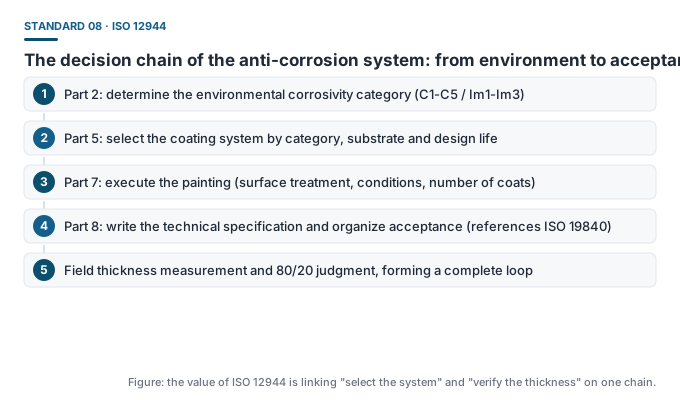
ISO 12944 does not solve “how to measure thickness”; it solves “how thick should it be”. First the environmental corrosivity category sets the coating system and design thickness, then thickness measurement verifies whether the work meets the spec — this is the common approach in European and American anti-corrosion engineering.
Series structure
| Part | Content |
|---|---|
| Part 1 | General |
| Part 2 | Environmental classification: atmospheric corrosivity C1-C5, water and soil Im1-Im3 |
| Part 3 | Design considerations |
| Part 4 | Surface types and surface preparation |
| Part 5 | Coating system selection |
| Part 6 | Laboratory performance testing |
| Part 7 | Application and supervision of painting |
| Part 8 | Preparation of specifications for new work and maintenance |
| Part 9 | Protective paint systems and laboratory performance testing for offshore and related structures |
Part 2: corrosivity category is the starting point
Part 2 divides atmospheric corrosivity into five categories; this is the input parameter for the whole system:
| Category | Environment description |
|---|---|
| C1 | Very low: heated indoor environments, such as offices, shops |
| C2 | Low: low-pollution atmosphere, mostly rural; unheated indoor spaces that may condense |
| C3 | Medium: urban and industrial atmosphere, moderate sulfur-dioxide pollution; low-salinity coastal areas |
| C4 | High: industrial areas and moderate-salinity coastal areas |
| C5 | Very high: high-humidity high-salinity industrial areas, coastal and offshore zones |
| Im1-Im3 | Environments immersed in water or buried in soil, graded by nature |
The higher the category, the stricter the performance requirement on the coating system, and usually the larger the design thickness.
Part 5 and Part 8: from selection to acceptance
Part 5 gives coating system combinations by substrate, corrosivity category and expected life (e.g. low, medium, high durability): the number and type of primer, intermediate and top coats. Part 7 specifies execution; Part 8 specifies how to write the above requirements into a technical specification and organize acceptance — including thickness acceptance, referencing ISO 19840.
Practical impact on thickness measurement
- Coating systems in C3 and C4 environments are typically hundreds of micrometers;
- Systems in C5 and immersion environments are thicker, possibly entering the millimeter range;
- Thick coatings mean gauges with larger ranges are needed, and watch the trade-off between range and resolution;
- Readings on rough blasted surfaces must be baseline-corrected, otherwise thickness is overestimated.
Corresponding models in the Dongru product line
For thick coating systems in C4 and C5 environments, the corresponding models are DR5000S (0-5000 μm), DR6000A (0-6000 μm) and DR9000A (0-10000 μm); for ultra-thick systems such as fireproofing, DR15A (100 μm-15 mm) can be used. All are magnetic-method models for steel substrates.
Common misconceptions
- ❌ “ISO 12944 specifies how thick the coating must be” — it specifies the system-selection method and acceptance framework; the specific thickness is set by the system design.
- ❌ “A higher corrosivity category is better” — the category describes environmental severity, set by the use environment, not a selectable metric.
- ❌ “ISO 12944 only applies to Europe” — it is an international standard, widely used in technical specifications for projects worldwide.