
The bottom line
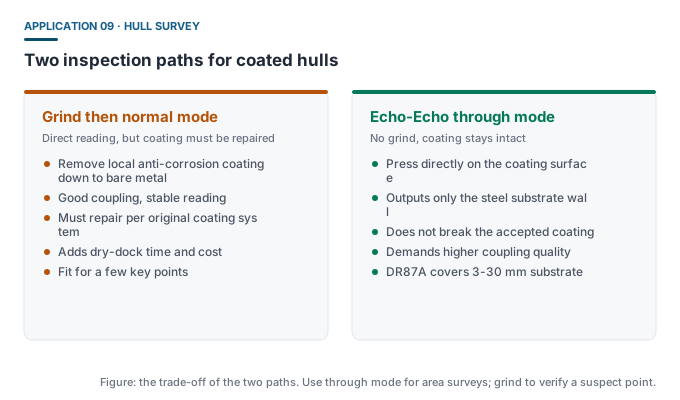
The biggest constraint in hull measurement is not accuracy but not breaking the anti-corrosion coating. Each grind point means an equal number of repair points, and repair quality is often worse than the original. Echo-Echo mode exists exactly to resolve this conflict.
Hull materials and matching methods
| Hull material | Method | Note |
|---|---|---|
| Steel (most merchant ships, some yachts) | UT thickness (pulse-echo / Echo-Echo) | Mainstream; prefer through mode when painted |
| Aluminium (high-speed craft, some yachts) | UT thickness (set aluminium velocity correctly) | Velocity differs clearly from steel; calibrate separately |
| Fibreglass / composite | UT thickness not applicable (for metal walls) | Needs dedicated composite inspection method |
Why hull survey leans so hard on through mode
- Hull anti-corrosion coating area is huge; per-point grinding labour and repair cost are very high;
- Underwater or dry-dock conditions are limited; fewer steps mean major cost difference;
- Once an accepted coating is broken, it must be rebuilt layer by layer per the original system, raising quality risk;
- Through mode completes the area survey with the coating intact, grinding only to verify suspect points.
The value of gridded measurement
The industry practice for hull survey is to divide the shell plating and internal structure into a grid (by frame and height), take several points per grid, and build a wall-thickness distribution record. Its value is threefold:
- Find local corrosion hot spots (e.g. ballast tank bottom, steering gear room, near drains);
- Compare with the last survey to assess corrosion rate;
- Provide a basis for repair scope and class survey.
The matching Dongru models
DR87A (0.55-500 mm, through 3-30 mm, +/- (0.5%H+0.05) mm, built-in Li-ion) is the main choice for coated hull survey; if the hull is new-built or already ground, DR86A (0.55-500 mm, high-accuracy wide range) gives better reading quality; DR89S (0.15-300 mm, single-crystal probe) fits thin plate and high-accuracy spots.
Common misconceptions
- “Through mode fully replaces grinding” — loose rust and soft old paint still need cleaning, or coupling is unstable.
- “Fibreglass hulls can also use a UT thickness gauge” — the principle targets metal walls; fibreglass needs a dedicated method.
- “One hull measurement completes the survey” — wall thickness is only one input to structural survey; full hull survey also covers visual structure, coating state and weld inspection.