
The bottom line
Echo-Echo (through-coating) mode solves one very specific field problem: the part is already fully coated, and you still want to know how much steel is left. It subtracts the coating using the interval between successive echoes, at the cost of needing better coupling and stricter surface conditions.
How normal mode differs from through-coating mode
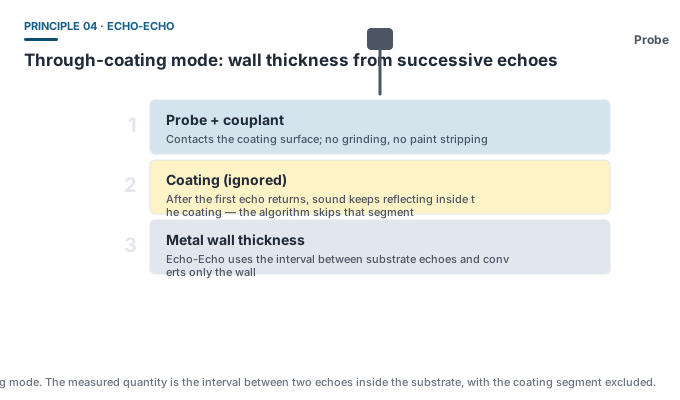
Normal pulse-echo mode distinguishes only the first echo and the first back-wall echo, and the coating sits between them. Measuring a painted pipe in normal mode therefore gives you coating plus steel, a number with no meaning for corrosion assessment.
Echo-Echo mode instead records multiple successive echoes: the coating surface echo, the coating/metal interface echo, the first back-wall echo, the second back-wall echo, and so on. By comparing intervals between echoes of the same kind, the gauge can isolate the segment that lies inside the substrate.
| Normal pulse-echo | Echo-Echo through-coating | |
|---|---|---|
| Measured quantity | Total part thickness, coating included | Substrate wall thickness only |
| Works through paint | Yes, but the reading includes the film | Yes, and the film is excluded |
| Surface preparation | Routine cleaning | Cleaning required, grinding not required |
| Coupling demand | Normal | Higher — multiple echoes must be resolvable |
| Typical models | DR83A / DR85A / DR86A | DR87A |
What it actually saves
- Grinding: once a hull, tank or pipe coating is ground back, the coating system must be reinstated, which costs far more than the measurement itself;
- Downtime: in-service equipment can be inspected without draining or paint removal;
- Risk: an accepted coating system is left intact, so no new corrosion initiation sites are created;
- Time: grinding and repair usually account for most of the labour hours in a wall thickness survey.
The working window
Through-coating mode is not unlimited. On Dongru DR87A the normal mode covers 0.55-500 mm (steel) and through-coating mode covers a substrate thickness range of 3-30 mm. Below or above that window the multiple echoes become hard to resolve and the reading fails or drifts.
When through-coating mode fails
- The coating is too thick (several millimetres of heavy anti-corrosion system) or heavily filled, so the sound is fully attenuated inside it;
- The coating and substrate have similar acoustic impedance, so the interface echo is weak;
- The back wall is pitted by corrosion, scattering the return;
- Poor coupling — the most frequent cause in the field, and usually fixed immediately by re-applying couplant.
The Dongru model that uses it
DR87A is Dongru’s through-coating ultrasonic thickness gauge (0.55-500 mm, through-coating 3-30 mm, ±(0.5%H+0.05) mm, built-in Li-ion). Where the job does not need through-coating capability — bare parts, or parts that may be ground — DR86A and DR89S offer a better combination of range and accuracy for the money.
Common misconceptions
- “With through-coating mode I never need to grind again” — loose rust, mud and flaking old paint still must be removed, otherwise the coupling is unstable.
- “Through-coating accuracy equals normal mode” — it relies on multiple echoes with a lower signal-to-noise ratio, so repeatability is usually slightly worse than normal mode.
- “It can penetrate any coating thickness” — the thicker the coating, the more the sound attenuates. Seeing a back-wall echo requires that energy is left.