
The bottom line
Choosing a gloss meter needs just one answer: is the surface shiny, matte, or does it need multi-angle evaluation. Pick the wrong angle and the reading loses comparability.
Incidence angle decides the suited range
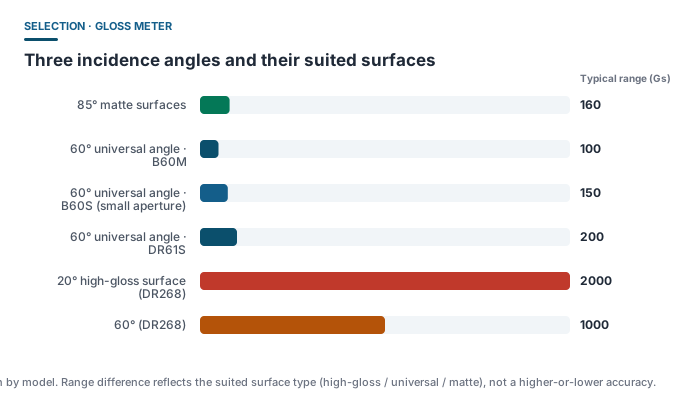
| Incidence angle | Suited surface | Dongru model | Range |
|---|---|---|---|
| 20° | High-gloss surfaces: polished metal, high-gloss paint, mirror materials | DR268 (tri-angle includes 20°) | 0-2000Gs |
| 60° | Universal angle, widest applicability | DR60A / DR61S / B60M / DR268 | 0-1000Gs to 0-200Gs |
| 85° | Matte, low-gloss surfaces: matte coatings, paper, fabric texture | DR268 (tri-angle includes 85°) | 0-160Gs |
Gloss is a relative quantity
Gloss is defined as the ratio of a specimen specular-reflected flux to a standard plate reflected flux, expressed in gloss units (Gs). It has no absolute physical dimension, therefore:
- It only makes sense to compare at the same incidence angle and on the same scale;
- Different instruments may have different standard-plate references; verify calibration before cross-instrument comparison;
- The instrument must be calibrated periodically with its supplied standard plate, which itself must be sent for calibration on a schedule.
General, tri-angle and small-aperture
| Type | Model | Suited scenario |
|---|---|---|
| Single-angle (60°) portable | DR60A (0-199.9, indication error <1.2) | Gloss inspection of paint, plastic, stone, paper surfaces; economical and portable |
| Single-angle (60°) smart | DR61S (0-200Gs, 2.4-inch colour screen, 3000mAh Li-ion) | Same scenarios, with colour screen and Li-ion |
| Metal high-gloss dedicated | B60M (0-100Gs) | High-gloss surfaces of metal and coatings |
| Small-aperture | B60S (0-150Gs) | Curved surfaces, small irregular workpieces — surfaces a normal large spot cannot cover |
| Tri-angle | DR268 (20° 0-2000Gs / 60° 0-1000Gs / 85° 0-160Gs) | Scenarios needing multi-angle evaluation of one surface, e.g. automotive paint, high-gloss plastic |
When tri-angle is mandatory
- When you must evaluate both high-gloss and matte features together (e.g. metallic flake paint);
- When a material behaviour at different angles is itself a quality metric;
- When you need to interface with a global customer or upstream standard multi-angle data.
If it is only routine 60° gloss inspection, a single-angle model has better value.
When a small aperture is mandatory
The value of a small-aperture model is compressing the measurement spot very small, so it can measure curved surfaces and small irregular workpieces. A normal large-spot model on these surfaces reads low because of a penumbra effect. Dongru B60S is built for exactly this (0-150Gs, 60° small aperture).
Common misconceptions
- ❌ “Higher gloss number is always better” — it depends on the product requirement. Matte products call for low gloss.
- ❌ “60° reading of 80Gs equals 85° reading of 80Gs” — different angles have different ranges and sensitivities; readings are not directly comparable.
- ❌ “The standard plate needs no calibration” — the standard plate is part of the traceability chain; its own drift invalidates all measurements.