
The bottom line
Write the answers to these 10 questions into your RFQ, then re-check them on receipt — far more effective than repeatedly comparing spec sheets.
Part 1: can it be used (questions 1-3)
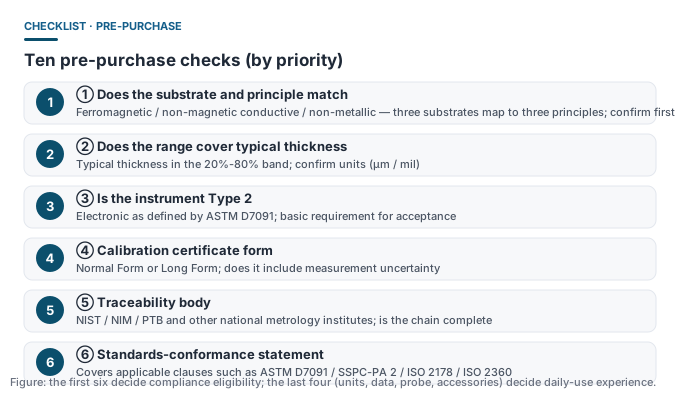
1. Does the substrate and principle match?
Answer: ferromagnetic substrate uses magnetic induction, non-magnetic conductive substrate uses eddy current, non-metallic substrate uses ultrasonics. Require the supplier to state clearly the substrate types the model fits, not vaguely “universal”.
2. Does the range and accuracy cover typical thickness?
Require the full accuracy expression, e.g. ±(1%~3%)H+1.5μm, and state the concrete tolerance at your typical thickness point. Also confirm whether units support μm / mil switching.
3. Is the instrument Type 2?
ASTM D7091-22 divides gauges into Type 1 (magnetic pull-off) and Type 2 (electronic). Acceptance needs Type 2. Require written confirmation.
Part 2: can it be used for acceptance (questions 4-7)
4. What form is the calibration certificate?
Normal Form only lists readings; Long Form additionally gives measurement uncertainty, traceability chain and environmental conditions. Contractor audits usually require Long Form.
5. Traceable to which national metrology institute?
NIST (US), NIM (China), PTB (Germany) are equivalent under the CIPM-MRA framework. Require a certificate that shows a complete traceability chain with no break.
6. Can a standards-conformance statement be provided?
The statement should cover the clauses you actually need to cite: ASTM D7091-22, SSPC-PA 2-2022, ISO 2178:2016, ISO 2360:2017, ISO 19840:2012 and so on. Note this is a different document from the calibration certificate.
7. Are there other certification requirements?
Products with wireless modules need FCC certification to sell in the US; rechargeable products may be asked by wholesale buyers and insurers about third-party certifications such as UL / ETL. Confirm status and timeline one by one.
Part 3: is it easy to use (questions 8-10)
8. What is the data capability?
Whether it supports statistics such as average, extreme and standard deviation; what the storage capacity is; whether it can export to a PC to generate acceptance records. The 80/20 decision needs grouped data, and this capability directly affects work efficiency.
9. Can the probe be replaced separately?
The probe is a replaceable and wear part. Whether it can be purchased separately, at what price, and whether recalibration is needed after replacement all affect long-term cost of ownership.
10. How about power and accessories?
Dry battery or built-in Li-ion; whether it ships with reference shims, couplant (ultrasonic), test blocks, a carrying case and manuals; warranty period and after-sales response method.
Turn the checklist into an RFQ
We recommend organising the 10 items above into a table to send the supplier, requiring a written reply item by item. The benefit is comparability — different suppliers replies land on the same table and differences are obvious at a glance, instead of each sending a brochure.
Common misconceptions
- ❌ “A calibration certificate means compliance” — you must also check the certificate form, whether it has uncertainty, and whether the instrument type meets the requirement.
- ❌ “The accuracy on a spec sheet can be compared directly” — you must convert to the same thickness point; the weight of the proportional and fixed terms differs greatly.
- ❌ “Accessories can wait” — reference shims and probes are daily essentials; missing parts directly stop the instrument from running its verification procedure.