
The bottom line
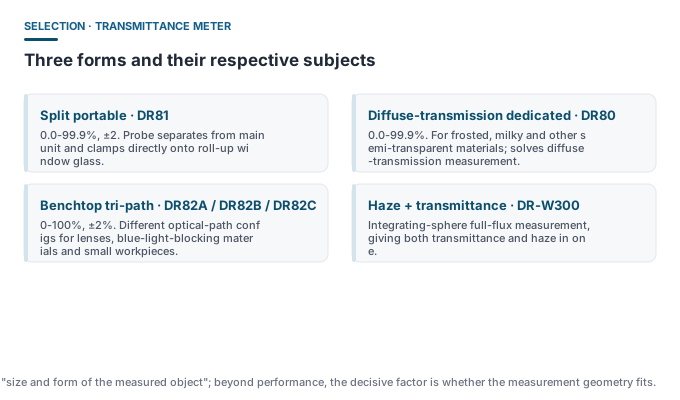
Transmittance-meter selection does not hinge on accuracy (most models are ±2%) but on whether the measured object can be placed into the measurement optical path: the window must be clamped, the lens must be aimed at a small aperture, and frosted material needs diffuse-transmission handling.
Three forms
| Form | Feature | Suitable object | Dongru model |
|---|---|---|---|
| Split portable | Probe separates from main unit, clamps on site | Vehicle-window glass, plates, film | DR81 (0.0-99.9%, ±2) |
| Benchtop | Fixed optical path, small test aperture | Eyeglass lenses, phone-camera lens, small workpieces | DR82A (1.3mm aperture) / DR82B (blue-violet) / DR82C (IR ink hole) |
| Diffuse-transmission dedicated | Designed for scattered-light measurement | Frosted, milky semi-transparent materials | DR80 |
| Integrating-sphere | Full-flux measurement, can measure haze | Haze and transmittance of plastic, film, glass | DR-W300 |
Key judgement: regular or diffuse transmission
This is the easiest point to get wrong.
- Regular-transmission materials (clear glass, acrylic, film): light passes essentially along the original direction; a general transmittance meter suffices;
- Diffuse-transmission materials (frosted glass, milky plastic, diffuser film): light is strongly scattered on passage; a conventional optical path underestimates transmittance, so a dedicated diffuse-transmission model such as DR80 is needed.
Optical-path breakdown of benchtop models
DR82A / DR82B / DR82C use different optical-path configs for different evaluation bands and workpiece sizes:
| Model | Optical-path feature | Suitable scenario |
|---|---|---|
| DR82A | Tri-path parallel optical path | General optical-transmittance testing, 1.3mm aperture, suits small workpieces |
| DR82B | Tri-path optical path | Blue-violet band transmittance of eyeglass lenses and blue-light-blocking materials |
| DR82C | Tri-path optical path | Local transmittance of phone-camera lens IR ink holes |
All three are benchtop external-DC-power models (DC-5V), suited to fixed inspection benches.
Division of labour with haze
Transmittance measures “how much passes through”, haze measures “how much scatters”. They are independent and cannot be converted into each other. When both figures are needed at one station, choose the integrating-sphere model DR-W300 (transmittance + haze in one, DC12V benchtop).
Scenario-to-selection mapping
| Scenario | Recommended model | Reason |
|---|---|---|
| Vehicle-window film field inspection | DR81 | Split probe clamps directly onto the glass |
| Glass / acrylic / film QC | DR81 / DR80 | Choose by whether the material is regular or diffuse transmission |
| Eyeglass blue-light-blocking inspection | DR82B | Covers the blue-violet band |
| Phone-lens IR ink hole | DR82C | Benchtop small-aperture measurement |
| Haze and transmittance of plastic film | DR-W300 | Integrating-sphere outputs both |
Use and calibration
Transmittance is a relative measurement and must be verified against a reference standard at the manufacturer-specified interval to keep source and detector stable. Avoid ambient-light interference — especially with split models, keep strong side light from hitting the probe opening directly.
Common misconceptions
- ❌ “A transmittance meter is universal” — regular and diffuse materials need different measurement geometry; using the wrong one gives systematically low results.
- ❌ “A phone app can replace it” — acceptance and compliance need a dedicated instrument whose spectral response and geometry meet the standard.
- ❌ “Higher transmittance means lower haze” — they are independent; a material can be high-transmittance and high-haze.