
The bottom line
Selecting an ultrasonic thickness gauge only needs three answers: how thick is the workpiece, does the surface have a coating, and is grinding allowed. The three answers decide the model class; everything else is configuration detail.
Question 1: how thick is the workpiece
| Thickness band | Recommended model class | Dongru model |
|---|---|---|
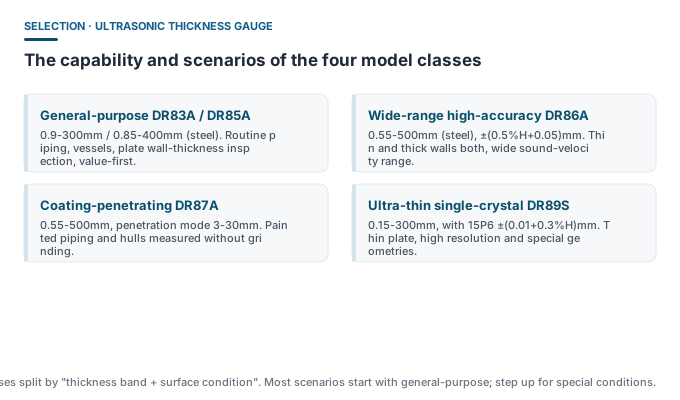
| 0.15-1mm (thin plate, sheet metal) | Ultra-thin single-crystal or ultra-thin mode | DR89S |
| 1-50mm (routine piping and vessels) | General-purpose | DR83A / DR85A |
| 50-300mm (thick walls and forgings) | Wide-range | DR86A / DR85A |
| 300-500mm (extra-thick workpieces) | Wide-range high-accuracy | DR86A |
| Coated (any thickness) | Coating-penetrating | DR87A |
Question 2: does the surface have a coating
If the workpiece surface has an intact anti-corrosion coating and destruction is not allowed, you must choose a model that supports coating-penetration (Echo-Echo) mode. Dongru DR87A penetration mode covers a base-material thickness range of 3-30mm, suitable for painted piping, hulls and storage tanks.
Question 3: is grinding allowed
- Grinding not allowed (in-service equipment, already-accepted coating): coating-penetration mode;
- Local grinding allowed: general-purpose or wide-range, the most direct reading;
- New, unpainted parts: normal mode suffices, and higher-accuracy models can be prioritised.
Probe and sound velocity: two easily overlooked configurations
The probe decides the lower measurement limit and the applicable geometry: dual-crystal probes suit routine rough surfaces, single-crystal probes suit thin walls and high-resolution needs, small-diameter probes suit curved surfaces and tight spots. When buying, confirm the probe is replaceable and can be purchased separately.
Sound-velocity range is equally key. Metal sound velocities vary widely: steel about 5900m/s, aluminium about 6320m/s, copper about 4700m/s, glass about 5600m/s. A wide sound-velocity setting range (e.g. 509-18699m/s) means the gauge works on more materials, not just steel.
How to read the accuracy expression
| Model | Accuracy | Note |
|---|---|---|
| DR83A / DR85A | ±(1%H+0.1)mm | 1% proportional term, 0.1mm fixed term; at 100mm the tolerance is ±1.1mm |
| DR86A / DR87A | ±(0.5%H+0.05)mm | Half the proportional term, suits high-accuracy situations |
| DR89S | ±(0.01+0.3%H)mm (with standard 15P6) | Only 0.01mm fixed term, 0.3% proportional term, suits thin plate |
Common misconceptions
- ❌ “Wider range is better” — a wide-range model may not outperform a dedicated thin-plate model at small thicknesses.
- ❌ “Coating-penetration mode can fully replace grinding” — loose rust and soft old paint still need cleaning, or coupling becomes unstable.
- ❌ “Probes are universal, any one will do” — probe and instrument frequency and impedance must match, and the probe decides the lower limit and applicable geometry.