
The bottom line
The key to tint compliance is not “what the film is rated” but how much light the whole glass assembly still transmits after installation. Enforcement measures the glass assembly, not the film itself.
Why there is no uniform US standard
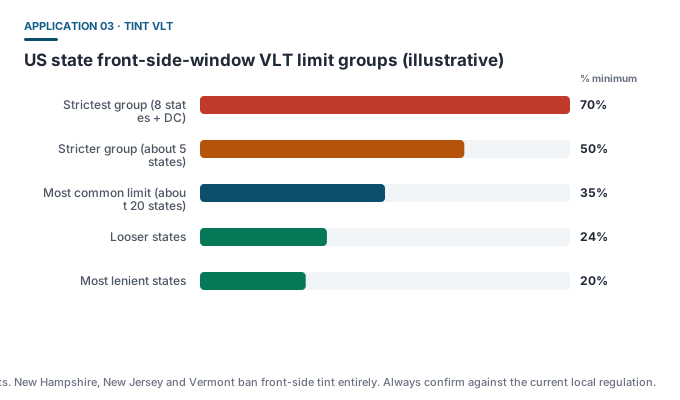
Window tint in the US is a state-level matter; all 50 states and DC set their own rules, so the same film can be legal in one state and illegal in another. The breakdown is roughly:
| Group | Front side window VLT | Examples |
|---|---|---|
| Strictest | 70% | 8 states incl. California (front side), New York (all windows) + DC |
| Stricter | 50% | about 5 states |
| Most common | 35% | about 20 states |
| Looser | 20%-24% | New Mexico 20%, Montana / Washington 24% |
| Front side banned | Not allowed | New Hampshire, New Jersey, Vermont |
The net VLT trap: why a 50% film can still be cited
Factory driver-vision glass already carries a transmittance requirement. Under US federal motor vehicle safety standard FMVSS 205 and ANSI/SAE Z26.1, the factory transmittance of driver-vision glass is about 70%.
After film, the net transmittance of the assembly is the product of the two:
Net VLT = factory glass VLT x film VLT. At 70% factory and 50% film: 70% x 50% = 35%.
In a state requiring 70% front side, that result is clearly non-compliant. What the buyer sees as “50% transmittance” is the film parameter — the two are not the same, which is the most common misconception in tint compliance.
- To hit net VLT >= 70% on the front side you need a film near 100% transmittance — effectively no film;
- To hit net VLT >= 35% you need film transmittance no lower than about 50%;
- When the factory glass baseline is unknown, measure the same untinted glass to get the baseline; do not assume.
Who needs to measure this
| Role | Use |
|---|---|
| Tint shops | Show customers the film blocking performance and the measured post-install transmittance — a credibility builder in the sales step |
| Used-car dealers / owners | Self-check to avoid penalty risk from non-compliant tint |
| Glass and film makers | Outgoing inspection of the material own transmittance |
| Acrylic and frosted-material makers | Transmittance of diffuse-transmission materials (DR80 applies) |
How to choose the instrument
Transmittance measurement needs an instrument covering the visible band with a stable light source and detector geometry. Dongru DR81 is a split-type transmittance meter (0.0-99.9%, +/-2), whose separated probe clamps directly onto a rolled-up window for vehicle use; DR80 is aimed at frosted and milky-white diffuse materials.
Recent changes worth watching
- Florida moved to state-certified digital transmittance meters for tint checks; first offence up to $150, repeat up to $500;
- Iowa lowered the front-side limit from 70% to 50% (effective July 1);
- North Carolina dropped the tint check from annual inspection, moving to roadside enforcement.
- These shifts show tint compliance moving from “inspection item” to “roadside item”, raising demand for self-check tools.
Common misconceptions
- “Buy 35% film and you meet a 35% state” — you still multiply by the factory glass 70%, so the real net is only about 24.5%.
- “If it looks clear after tinting you are fine” — visual judgement is unreliable, and enforcement uses the instrument reading.
- “Dark film only fails on front side, other windows are free” — states differ on rear side and rear windshield; check each clause.