
The bottom line
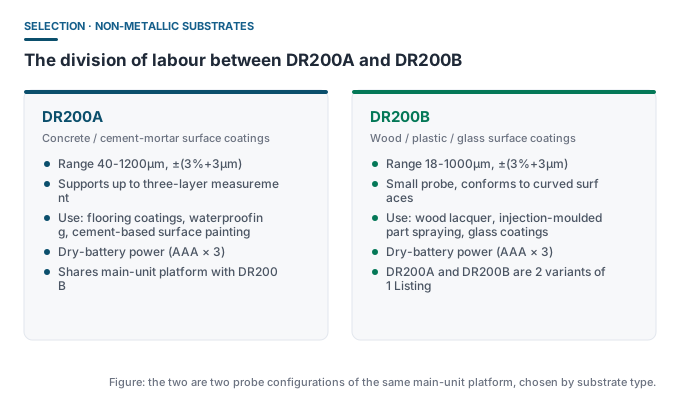
Selection for non-metallic substrates is unusually simple: look at the substrate. Concrete and mortar use DR200A; wood, plastic and glass use DR200B. There is no second decision dimension, because the available dedicated models are themselves scarce.
Why there are so few instruments of this type
Magnetic induction and eddy current cover the vast majority of industrial scenarios; non-metallic substrates are a “long-tail need”. And ultrasound gives weak echoes and hard interface separation in low-acoustic-impedance materials, a higher technical bar than steel-based instruments. Supply scarcity shows directly in price: dedicated equipment of this kind usually sells well above conventional magnetic/eddy models.
Comparison of the two models
| Item | DR200A | DR200B |
|---|---|---|
| Applicable substrate | Concrete, cement mortar | Wood, plastic, glass |
| Range | 40-1200μm | 18-1000μm |
| Accuracy | ±(3%+3μm) | ±(3%+3μm) |
| Layered measurement | Up to three layers | Per actual configuration |
| Probe | Standard configuration | Small probe, conforms to curved surfaces |
| Power | Dry battery (AAA × 3) | Dry battery (AAA × 3) |
| Typical application | Flooring coatings, waterproofing, cement-based surface painting | Wood lacquer, injection-moulded part spraying, glass coatings |
Range conversion and outward expression
DR200A 1200μm is about 47 mil, DR200B 1000μm is about 39 mil (1 mil = 25.4 μm, round down in conversion). Because the measured object is the coating, the unit should follow coating convention (mil in the US market), not the mm usually used for substrate wall thickness.
The value of layered measurement
Wood lacquer and flooring coatings are often multi-layer systems. A qualified total thickness does not mean every layer is qualified — a missed primer or too-thin topcoat is only found by layered measurement. DR200A supports up to three layers of layered measurement, which is an advanced capability among comparable products.
What to confirm when purchasing
- Coupling medium: non-metallic substrates give weak echoes, so coupling-condition stability directly affects the upper readable limit;
- Number of measurement points and acceptance rule: agreed per project spec; ASTM D6132 and ISO 2808 give method basis but do not set thresholds;
- Probe replaceability: whether the probe can be purchased separately affects long-term cost;
- Substrate-condition record: the moisture content of concrete and wood affects sound velocity, so measurement conditions should be recorded.
Common misconceptions
- ❌ “Buy one to try, deal with it if it cannot measure” — instruments for non-metallic and metallic substrates are completely non-interchangeable; confirm the substrate type before purchasing.
- ❌ “Wider range is better” — DR200A and DR200B each target a substrate; range difference is only secondary.
- ❌ “This instrument can replace an ultrasonic thickness gauge” — the former measures coatings (micrometres), the latter measures substrate wall thickness (millimetres); different uses.