
The bottom line
Moving from the Chinese market to the US market, the product itself may need no change — what must change is the document system behind the product. And that document system is exactly the entry condition for professional procurement.
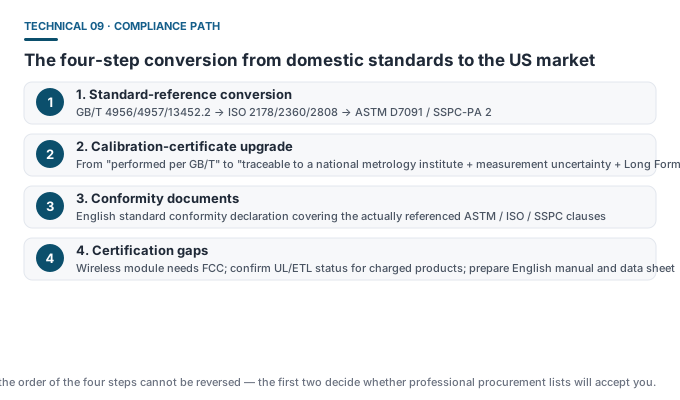
Step 1: standard-reference conversion
China coating-thickness national standards have identical-adoption relationships with international standards — same technical content:
| Measurement | China GB | International | US system |
|---|---|---|---|
| Magnetic gauging | GB/T 4956 (= ISO 2178) | ISO 2178:2016 | ASTM D7091-22 |
| Eddy-current gauging | GB/T 4957 (= ISO 2360) | ISO 2360:2017 | ASTM D7091-22 |
| Paint film thickness | GB/T 13452.2 (= ISO 2808) | ISO 2808:2019 | ASTM D7091 / D6132 |
| Thickness acceptance | — | ISO 19840:2012 | SSPC-PA 2-2022 |
Step 2: calibration-certificate upgrade
US coating-thickness measurement specifications require the dry-film gauge to be supplied with a certificate traceable to a national metrology institute. This means a qualified certificate must contain:
- A clear traceability chain (traceable to NIST, NIM or PTB);
- The measurement uncertainty and its coverage factor;
- An analysis of the uncertainty sources;
- The environmental conditions at measurement;
- The certificate in Long Form.
None of this requires redeveloping the product; it requires building a standardised calibration and certification process.
Step 3: conformity declaration
The calibration certificate proves the value is traceable; the conformity declaration states that the product meets the technical clauses of the standard. They are different kinds of documents and must be prepared separately.
The declaration should cover the clauses actually referenced — for example ASTM D7091-22 (instrument Type 2 and operational requirements), SSPC-PA 2-2022 (acceptance applicability), ISO 2178:2016 and ISO 2360:2017 (method applicability). It should also state whether it is a manufacturer self-declaration or issued by a third party.
Step 4: certification and document gaps
| Item | Requirement | Impact |
|---|---|---|
| FCC certification | Products with a wireless module (Bluetooth, etc.) must complete it to sell in the US | Missing it leads to delisting |
| UL / ETL | Usually not mandatory for charged products, but asked by platforms, wholesale buyers, insurers | Affects large-account deals |
| English manual | Professional buyers need it archived for audit | Affects procurement evaluation |
| English calibration-certificate template | Supplied with goods or available on request | Affects acceptance use |
| Quotation and package dimensions | Used to calculate first-leg logistics and margin | Affects pricing and launch decisions |
Priority order of the conversion
- Do standard references and the conformity declaration first — they decide whether the product is accepted into professional procurement lists, at the lowest cost;
- Then upgrade the calibration certificate — it decides whether you enter the contractor procurement flow, and needs a certification process;
- Then fill certification gaps — FCC is a statutory requirement and must be done; UL/ETL proceeds per customer demand;
- Finally refine the English materials and commercial information — it decides deal efficiency.
Common misconceptions
- “Same product parameters means you can sell directly” — professional-market access depends on the document system, not just parameters.
- “CE is enough” — CE, the US FCC and UL are different systems and cannot substitute for each other.
- “Any calibration certificate will do” — a certificate lacking uncertainty and a traceability chain is not accepted in an audit.