
The bottom line
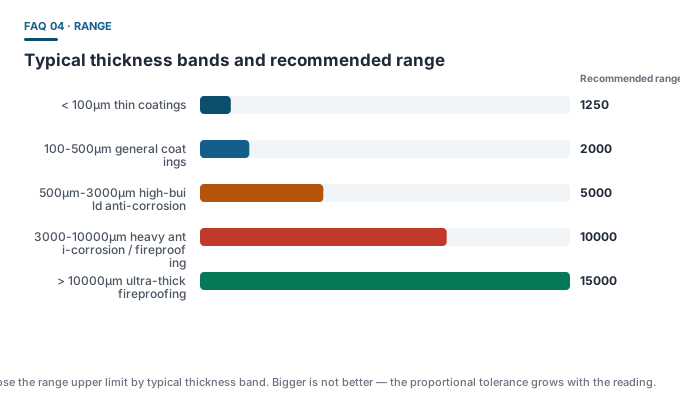
The only principle of range selection is match: keep typical thickness in the middle of the range. Too big wastes accuracy; too small simply will not work.
Three common range-selection mistakes
The range must cover typical thickness yet avoid over-configuring for rare conditions — both deviations carry long-term cost, and the latter is easy to miss at purchase time.
- Selecting range by the thickest condition — buying a wide-range model for a thick-coating job that happens a few times a year costs you a larger absolute tolerance on daily thin coatings, because the proportional term in the accuracy expression grows with the reading.
- Treating range width as capability — a wide range does not mean uniform accuracy across it. The same gauge has different allowable deviation near the lower limit versus near the upper limit.
- Watching the upper limit, ignoring the lower — an ultrasonic gauge’s lower limit decides whether it can measure thin walls. For example the DR89S lower limit of 0.15mm is exactly why it handles ultra-thin automotive sheet.
Confirm these three together with the unit expression (mil / μm) and range selection will rarely need rework.