
The bottom line
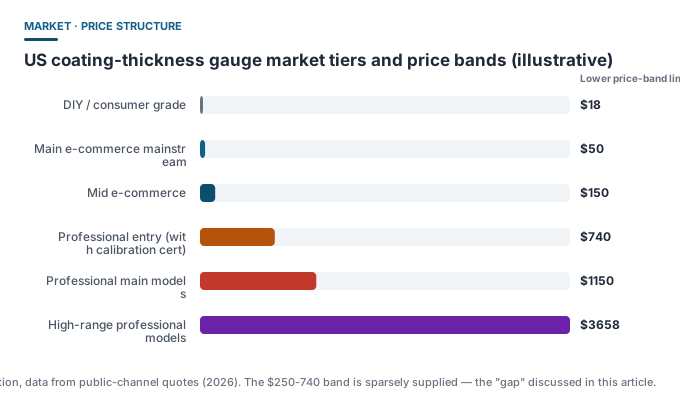
The shape of this market is not “cheap vs expensive” in two tiers, but three segments: a dense low end, a dense high end, and a thinly supplied transition band in between.
Three-segment structure
| Tier | Price band | Competitive focus | Typical features |
|---|---|---|---|
| DIY / consumer grade | $18-250 | Price and review count | Auto Fe/NFe recognition, limit alarm, data storage; aimed at car owners and DIY users |
| Transition band (sparsely supplied) | $250-740 | Compliance capability and parameter completeness | Contractors and small inspection firms that need compliant measurement; few optional products |
| Professional / industrial grade | $740 and up, high-range up to $3,000+ | Standards-conformance, calibration traceability, brand reputation | Provides traceable calibration certificates and a full standard list; price rises with range and probe configuration |
Why the middle is empty
Two supply-side inertia together create this void:
- Manufacturers targeting the consumer market tend to push cost to the minimum, clustering products below $250 to compete on price and reviews;
- Professional brands defend the high end with long-standing metrology systems, calibration labs and channel relationships, with prices rising along with certification and service cost.
Yet the demand side holds a real group: small contractors, inspection firms and factory QC departments that need compliant measurement per ASTM / SSPC specs but are unwilling to pay a four-figure budget for a single gauge.
The pass into this band
In the low end, the selling point is parameters and price; in the high end, it is brand and system. In the middle, what the buyer cares about most is one sentence: can this gauge enter my acceptance process. Answering this needs two documents:
- Traceable calibration certificate: explicitly require traceability to a national metrology institute (NIST / NIM / PTB all qualify), in Long Form with measurement uncertainty;
- Standards-conformance statement: covering applicable clauses such as ASTM D7091 / SSPC-PA 2 / ISO 2178 / ISO 2360 / ISO 19840.
Beyond that, the instrument type must be Type 2 electronic as defined by ASTM D7091 — a basic requirement for project acceptance.
What a product in this band should have
| Dimension | Requirement |
|---|---|
| Instrument type | Type 2 electronic, compliant with ASTM D7091-22 |
| Range | Covers common engineering thickness, typically 0-1250μm to 0-6000μm |
| Units | Supports μm / mil switching; US market uses mil as the primary expression |
| Calibration | Supports zero adjustment and reference-shim verification; can perform D7091 Adjustment |
| Data | Statistics such as average / extreme / standard deviation, to support acceptance decisions |
| Compliance | Can provide calibration certificate and standards-conformance statement; wireless modules need FCC certification |
Practical advice for buyers
- First pin down which standard your project spec cites (US projects mostly use SSPC-PA 2 + ASTM D7091);
- Then confirm the supplier can provide the corresponding conformance documents, not just a verbal claim;
- Only then compare range, accuracy and price — reversing the order causes repeated purchases.
Common misconceptions
- ❌ “Cheap ones can never be used for professional acceptance” — the deciding factor is compliance documents and instrument type, not the price itself.
- ❌ “Professional brands are pricey only because of brand premium” — metrology systems, calibration labs and service systems form the real cost.
- ❌ “Products with many reviews suit professional use better” — professional buyers decide on parameters and compliance documents; review count barely matters for bulk procurement.