
The bottom line
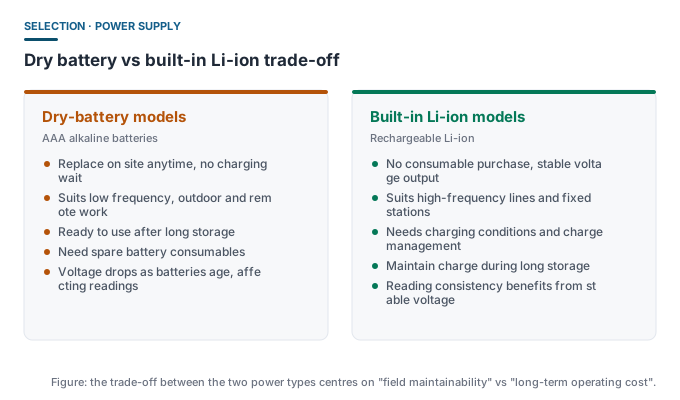
Power supply is not a technology-advancement metric but a fit-to-use-scenario question. Only three things decide it: how often you use it, whether you have charging, and whether you can buy batteries on site.
Three power forms
| Form | Feature | Suitable scenario | Dongru model examples |
|---|---|---|---|
| Dry battery (AAA alkaline) | Replaceable on site, no charging dependency | Outdoor engineering, low frequency, backup instruments | DR120 / DR220 / DR230 / DR320 / DR330 / DR80 / DR81 / DR60A |
| Built-in Li-ion | No replacement, stable voltage | High-frequency lines, fixed stations | DR-A5 / DR260A / DR280A / DR360A / DR370A / DR380A / DR5000S etc. |
| External DC power (benchtop) | Continuous supply, no battery limit | Laboratories, fixed inspection benches | DR82A / DR82B / DR82C / DR-W300 |
One easily overlooked point: voltage and readings
Magnetic and eddy current readings depend on probe-coil excitation and signal conditioning. As battery charge drops, voltage fluctuation can affect excitation stability and cause reading drift. Built-in Li-ion, with voltage-regulation management, is usually more stable here; dry-battery models should be replaced promptly at low charge and verified against a reference shim every shift.
Decide by usage frequency
- Daily use, fixed station: built-in Li-ion or benchtop external power is easier;
- Several times a week, moving between points: either works, depending on whether charging is available on site;
- Several times a month, kept as emergency backup: dry batteries fit better — install and use after long storage;
- Remote or no-power sites: dry batteries plus spares is the safer combination.
Other practical factors related to power
- Transport and compliance: products with built-in Li-ion are battery-class goods in international transport and must meet the relevant transport requirements; dry-battery products face simpler restrictions;
- Long storage: Li-ion not in use should be kept partly charged and topped up periodically to avoid deep discharge; dry batteries should be removed to prevent leakage;
- Replacement cost: in high-frequency use, the long-term consumable cost of dry batteries must be counted into total cost of ownership.
Common misconceptions
- ❌ “Li-ion is always more advanced than dry batteries” — they solve different problems; an outdoor model you cannot easily charge may be the better choice.
- ❌ “Power supply affects measurement accuracy” — nominal accuracy is unrelated to power supply, but voltage stability affects long-term reading consistency.
- ❌ “Benchtop is inconvenient so it is worse than portable” — benchtop gives more stable measurement conditions and more optical-path design room on a fixed bench (e.g. tri-path models).