
The bottom line
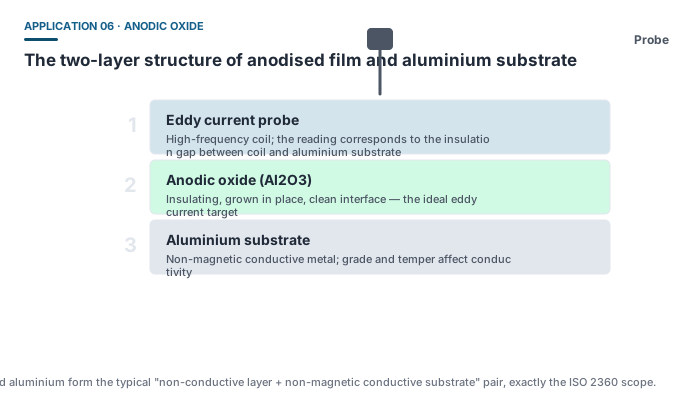
The anodic oxide layer is the “cleanest” eddy current target: the oxide is insulating, the interface is clean, and there is no primer or multi-layer structure. As long as you recalibrate when the alloy grade changes, readings are usually steadier than on spray coatings.
Why this pair fits eddy current so well
- The oxide (Al2O3) is an insulator, fully meeting “coating non-conductive”;
- The aluminium substrate is non-magnetic and conductive, meeting “substrate non-magnetic and conductive”;
- The oxide grows in place on the aluminium, with a flat interface and no transition layer or primer;
- Film thickness is usually in a controlled band, letting the gauge optimise resolution.
By contrast, spray coatings may have primer/topcoat layers, incomplete cure and rough surfaces — more variables.
Standards and process terms
| Item | Content |
|---|---|
| Measurement standard | ISO 2360:2017 (eddy current measurement of non-conductive coatings on non-magnetic conductive substrates) |
| Chinese equivalent | GB/T 4957 |
| Operating procedure | ASTM D7091-22 (non-ferrous substrate clauses) |
| Process types | Sulphuric acid anodising, hard anodising, chromic acid anodising, etc.; film thickness is closely tied to process |
| Common treatments | Colouring (dye or electrolytic) and sealing |
Measurement notes
- Recalibrate on grade change: 6061, 6063, 7075 and other common alloys differ in conductivity, shifting the reading baseline;
- Sealing and colouring do not change the interface nature: but residual sealant or dirt affects probe coupling, so clean and dry;
- Watch curvature on profiles: the fillets and slots of aluminium profiles have high curvature, so use a small-area probe or apply curvature correction;
- Hard anodising is thicker: confirm the range covers it, use a wider-range dual-mode model if needed.
The matching Dongru models
Pure eddy current models DR370A (0-1250 μm) and DR370B (0-500 μm) both measure aluminium surface-treatment layers; if the line also has steel parts, choose Fe/NFe dual-mode DR280A (0-1250 μm) or DR380A (0-2000 μm), which auto-identify the substrate and switch principle.
Common misconceptions
- “The oxide is non-conductive, so no instrument can measure it” — the opposite: exactly because it is non-conductive can it form an eddy-current-measurable interface with the conductive aluminium.
- “The same gauge reads differently on a new batch, so it drifts” — more likely the aluminium conductivity changed; re-do the substrate calibration.
- “Anodised film thickness rises with corrosion resistance, so thicker is better” — too thick a hard-oxide film gets brittle and cracks; set thickness per product standard and use.