
The bottom line
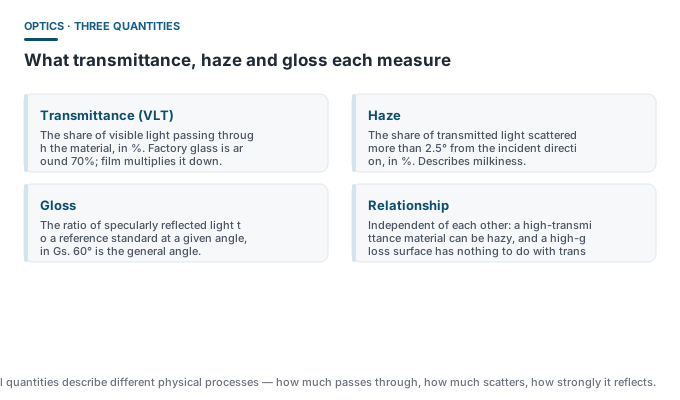
Transmittance, haze and gloss tend to be lumped together as “optical instruments”, but they measure three different things: transmission ratio, scattering fraction and specular reflection strength. Acceptance and compliance work has to pick the right one.
1 · Transmittance (VLT)
Transmittance is the share of visible light (broadly 380-780 nm) retained after passing through a material, expressed as a percentage. It is the most frequently measured quantity in window film, glass, acrylic and film industries.
In the US market this one carries legal weight: the visible light transmittance of front side windows is legislated state by state, with the strictest states requiring 70%. A field enforcement reading is therefore the basis for a citation.
| Application | What is measured | Dongru model |
|---|---|---|
| Window tint compliance self-check | Net VLT of the glazing assembly | DR81 (0.0-99.9%, ±2) |
| Glass / acrylic / film | Transmittance of the material itself | DR81 / DR80 |
| Frosted and translucent materials | Diffuse transmission ratio | DR80 (built for frosted and milky materials) |
| Lenses and blue-light filters | Transmittance in the blue-violet band | DR82B (3-in-1 optical path) |
| IR ink apertures on phone camera lenses | Local transmittance | DR82C (benchtop, 1.3 mm aperture) |
2 · Haze
Haze is the fraction of transmitted light scattered beyond a defined angle (typically 2.5°) relative to the incident direction, expressed as a percentage. It describes the milkiness or halation of a material and is independent of transmittance.
- High transmittance plus low haze equals clear, like optical glass;
- High transmittance plus high haze equals bright but milky, like frosted glass or diffusion film;
- Low transmittance plus low haze equals dark but sharp, like a deeply tinted solar film.
Dongru DR-W300 is a benchtop transmittance and haze meter using an integrating sphere for total luminous flux, reporting both quantities from one measurement.
3 · Gloss (unit: Gs)
Gloss is a relative quantity: the specular reflected flux from the specimen at a specified incidence angle, divided by that from a reference black glass standard, expressed in gloss units. It has no absolute physical meaning, so it is only meaningful when compared at the same angle and on the same scale.
| Incidence angle | Suitable surfaces | Typical range | Dongru model |
|---|---|---|---|
| 20° | High-gloss surfaces (metal, polished parts) | 0-2000 Gs | DR268 (tri-angle, includes 20°) |
| 60° | The general-purpose angle, widest applicability | 0-1000 Gs | DR60A / DR61S / B60M / DR268 |
| 85° | Matte and low-gloss surfaces | 0-160 Gs | DR268 (tri-angle, includes 85°) |
| 60° small aperture | Curved and small irregular parts | 0-150 Gs | B60S (small-aperture measurement) |
DR268 is the tri-angle model (20°/60°/85°), reporting all three angles from one measurement — useful where the same surface must be judged from multiple angles, such as automotive paint or high-gloss plastics.
The three quantities side by side
| Quantity | Unit | Definition | Key standards |
|---|---|---|---|
| Transmittance | % | Share of visible light passing through | ASTM D1003 / ISO 13468 |
| Haze | % | Scattered fraction of transmitted light | ASTM D1003 / ISO 14782 |
| Gloss | Gs | Specular reflection versus a reference standard | ASTM D523 / ISO 2813 |
Common misconceptions
- “High transmittance film must be clear” — haze matters too. High haze produces halation from oncoming headlights at night.
- “Gloss 80 at 60° and gloss 80 at 85° are the same thing” — gloss units at different incidence angles are not directly comparable.
- “A phone app is good enough to measure transmittance” — enforcement and acceptance work needs a dedicated instrument whose spectral response matches the standard.