
The bottom line
Professional procurement decisions rest on documents, not slogans. Preparing these documents beats polishing the spec sheet.
The real order of procurement evaluation
Before checking parameters, professional buyers check documents. Missing a key document, and the fullest spec sheet will not advance to the next round.
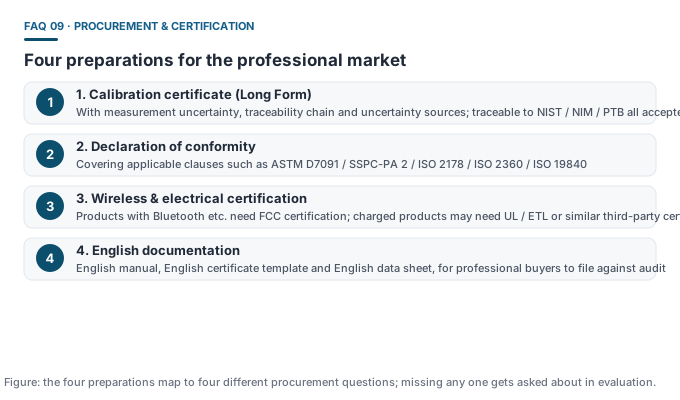
- Check the calibration certificate first — does it carry measurement uncertainty, the traceability chain and uncertainty sources (i.e. Long Form)? That is the proof of traceability and the entry threshold to a professional procurement list.
- Then the declaration of conformity — does it cover the standard clauses the project cites (e.g. ASTM D7091, SSPC-PA 2, ISO 2178 / 2360 / 19840), and is it maker self-declared or third-party issued?
- Finally market-access certification — products with wireless modules must have FCC certification to sell in the US; charged products may be asked for UL / ETL or similar third-party certification, usually not mandatory but often asked.
- Confirm all in writing — certification status should follow a written reply, not inference from marketing; a checklist of questions also eases side-by-side supplier comparison.
Turn these four into a fixed Q&A checklist and procurement communication shifts from repeated back-and-forth to one round of clear questions, and also eases fair comparison across suppliers.