
The bottom line
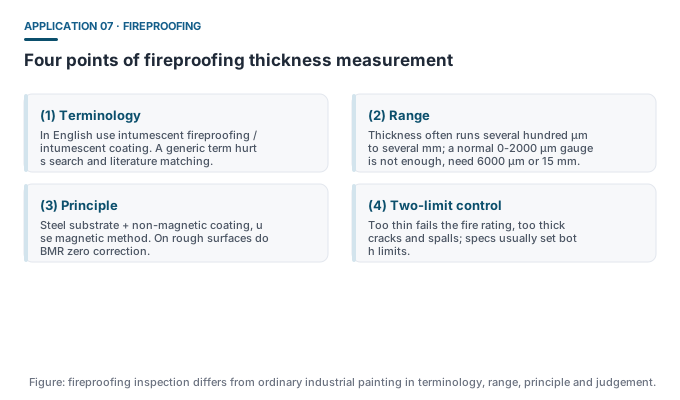
The technical difficulty of fireproofing thickness measurement is low — steel substrate, non-magnetic coating, magnetic method works directly. The real barriers are range and terminology accuracy: an ordinary coating gauge lacks the range, and the wrong English term keeps you from finding any useful reference.
Terminology: why you must say intumescent
Steel fireproofing coatings come in two types: intumescent and non-intumescent (e.g. cementitious, vermiculite thick-film). They are different entries in literature, product standards and search contexts.
- Intumescent coating / intumescent fireproofing: expands under heat to form an insulating char; thinner film but high expansion ratio;
- Non-intumescent fireproofing: insulates by its own low conductivity; usually a thicker film.
Using the precise term intumescent in technical search and product description is the prerequisite for finding the right literature and reaching the target users.
Why the range must be large
Intumescent fireproofing dry-film thickness typically runs from several hundred micrometres to several millimetres, depending on the designed fire rating (e.g. 60 min, 90 min, 120 min). A common 0-2000 μm coating gauge will over-range frequently on these jobs.
| Model | Principle | Range | Positioning |
|---|---|---|---|
| DR15A | Magnetic | 100 μm-15 mm | Fireproofing and heavy anti-corrosion ultra-thick coatings; +/-3%H+2 μm |
| DR6000A | Magnetic | 0-6000 μm | Thick anti-corrosion and fireproofing layers; +/-3%H+2 μm |
| DR9000A | Magnetic | 0-10000 μm | Ultra-wide-range fireproofing and anti-corrosion |
| DR5000S | Magnetic | 0-5000 μm | Pipeline anti-corrosion and thick coatings |
Measurement method points
- Surface prep: fireproofing surfaces are often rough; clear dust and loose particles;
- BMR correction: zero on bare steel of the same material, removing roughness effect;
- Spot layout: spread spots along the member length, paying attention to nodes, ends and faces with different fire exposure;
- Multiple readings: at least 3 readings per point averaged; single-point scatter is normal for fireproofing;
- Two thickness limits: check both minimum and maximum thickness against the design file.
Why too thick is also a problem
The fireproofing mechanism relies on foaming under heat to form an insulating layer. When the coating is too thick, the surface may crack and spall from thermal stress before foaming, and incomplete internal cure also hurts adhesion. So project specs usually give an allowed thickness band, not a single minimum.
The matching Dongru models
DR15A (100 μm-15 mm, built-in Li-ion) is the widest-range option, for ultra-thick fireproofing systems; DR6000A (0-6000 μm) and DR9000A (0-10000 μm) cover most fireproofing and heavy anti-corrosion scenarios; DR5000S (0-5000 μm) is the common setting for pipeline anti-corrosion. All four are magnetic, for steel substrate.
Common misconceptions
- “Any normal coating gauge handles fireproofing” — lacking range is a hard limit; past range the reading enters a non-linear region.
- “Searching fireproof coating is enough” — it pulls in non-intumescent products and building fireproofing materials; term precision directly affects information quality.
- “Thicker coating means longer fire time, more is better” — too thick brings crack and spall risk; specs usually set an upper limit.